
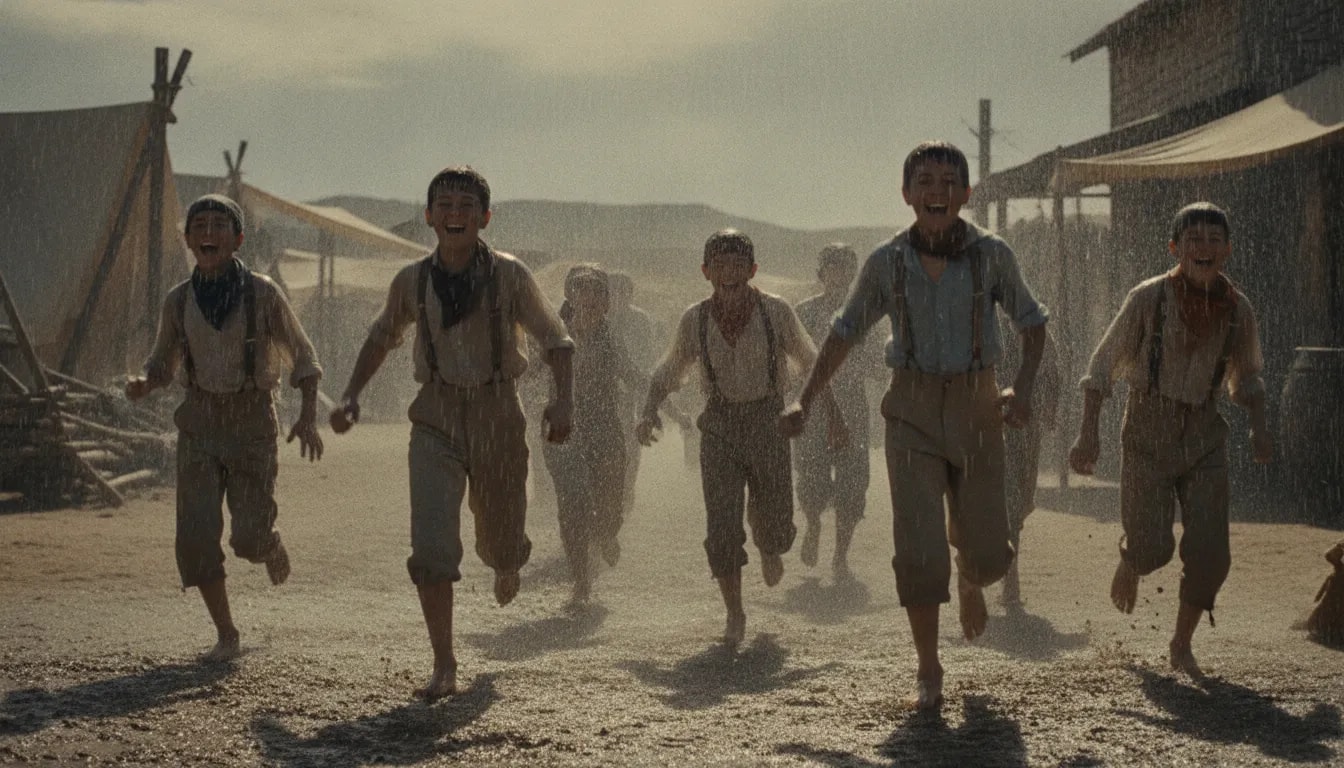
At Camp Green Lake, rain is not just weather.
It is release. It is proof that a place built around dust, heat, punishment, and control cannot stay frozen forever. When the sky finally breaks open in Holes, the rain changes the whole emotional shape of Camp Green Lake in an instant. The boys who have spent their time under the brutal desert sun are suddenly laughing, shouting, running, and lifting their faces to the water.
For a brief, beautiful stretch, the camp no longer belongs to the people who made it miserable.
It belongs to the kids.
A Dry Camp Built on Control
Camp Green Lake has the kind of name that sounds almost kind, almost peaceful. But nothing about the place feels green or lake-like. It is dry, dusty, exposed, and harsh. The environment reflects the system at the centre of the camp: a world where young people are made to work, obey, and accept whatever happens to them.
The boys wear the same orange uniforms. They move through the same baked-out yard. They are expected to keep digging and keep their heads down. Even the landscape seems to be against them.
That is why the approaching storm matters before a single drop falls.
When the clouds gather over the camp, everyone notices. Faces tilt upward. The boys pause and look at the sky as if they can barely believe what they are seeing. In a place where nothing seems to change, a storm signals that something finally might.
The shot of darkening clouds is simple, but it carries the weight of everything the camp has denied these kids: comfort, relief, freedom, and the chance to feel like ordinary young people again.
Rain does not arrive quietly here. It feels earned.
The Sky Changes, and So Does Everyone Below It
Once the rain begins, the entire camp erupts.
The boys do not stand under cover or complain about getting wet. They run directly into it. They throw their arms into the air, splash through the mud, dance, hug, and yell with the kind of joy that only makes sense after a long time without anything to celebrate.
It is messy, loud, and completely unrestrained.
That lack of restraint is the point. Camp Green Lake depends on routine. It depends on boys being lined up, watched, divided, and disciplined. Rain blows through that order. The uniforms are still orange, but now they are soaked. The dusty ground is still there, but it is turning to mud. The same yard that has functioned as a place of labour becomes a place of celebration.
Nothing has been rebuilt. No official rule has changed. Yet the emotional atmosphere has transformed.
The boys take back the space simply by refusing to act as though joy is forbidden.
Why the Celebration Is So Immediate
There is no hesitation once the rain falls. That makes the scene feel honest.
These boys have been living in conditions where water is not something to take for granted. A downpour is not an inconvenience. It is a miracle. It is something physical and undeniable after so much dryness.
The joy also comes from the fact that rain cannot be controlled by Camp Green Lake. Nobody can schedule it, confiscate it, punish it, or claim it as a reward for good behaviour. It belongs to everyone standing in the yard.
That shared freedom is what makes the celebration so moving. The boys are not competing with one another. They are not digging separate holes. They are not being pushed into isolation. They are gathered together in the same rain, reacting with the same disbelief and delight.
For once, nobody has to earn the right to be happy.
The orange uniforms become part of the image
Visually, the orange uniforms make the moment even stronger. Earlier, they mark the boys as part of the camp system. In the rain, the same uniforms become soaked, muddy, and almost ridiculous in the best possible way.
The camp’s attempt to make everyone look the same is still visible, but it no longer has the same power. Every boy reacts differently. Some dance. Some shout. Some reach up into the downpour. Some grab their friends. The uniform remains, but the individuality comes roaring back.
That contrast gives the scene its energy. The rain has not erased what the camp is, but it has interrupted its hold.
Friendship Becomes the Centre of the Scene
One of the strongest parts of this moment is how much it depends on connection. The rain brings out laughter and movement, but it also brings people together.
Friends find each other in the middle of the chaos. Boys touch shoulders, embrace, lean close, and share the kind of excitement that cannot be contained by one person. The celebration is never presented as a private victory. It is communal.
That matters because Camp Green Lake is designed to make relationships difficult. Hard places often encourage people to protect themselves first. They make trust feel dangerous. They make vulnerability seem like weakness.
But the rain creates a break in that emotional armour.
For a few minutes, nobody is pretending not to care. Nobody is acting tough for the camp. The boys are soaked, exhausted, ecstatic, and fully present with each other.
That is the emotional payoff. Rain brings water to the ground, but it also brings warmth back to the people living on it.
A Moment of Joy Does Not Erase What Happened
The scene works because it does not pretend that rain fixes everything.
There are still adults standing at the edge of the action. There is still tension around the camp. There are still serious consequences unfolding. The moment of joy exists alongside the reality that the boys have been living in a place built on fear and power.
This is important because the best kind of relief is not always neat. Sometimes happiness arrives before every problem is solved. Sometimes it shows up in the middle of chaos, when people need it most.
The rain at Camp Green Lake is not a tidy ending. It is a turning point.
The boys are allowed to feel free before they are fully free. They get a glimpse of another way to exist. They get proof that the world can contain something other than dry earth, hard work, and someone else’s rules.
The Adults at the Edge of the Rain
While the boys celebrate, the adults around Camp Green Lake are forced into a different position. They are no longer directing the scene. They are left observing it.
That shift is subtle but powerful.
For so long, authority has shaped every part of life at the camp. Adults determine where the boys stand, what they wear, when they work, and what happens when they step out of line. But the rain changes the balance. The adults can look on, but they cannot control the weather or contain the emotional release it creates.
The reactions at the edge of the camp are not as carefree as the celebration in the yard. There is surprise, discomfort, and an awareness that something bigger is happening. The storm has made visible what the camp tried to bury: the boys have endured more than they should have had to endure, and they are still capable of joy.
That is not a small thing.
Joy can be a form of resistance, especially in a place that expects people to be broken.
The camp cannot keep its old image intact
Before the rain, Camp Green Lake looks fixed and permanent. Its dirt, wood, uniforms, fences, and routines all suggest that this is simply how things are.
Then the storm arrives, and everything looks different.
The air fills with water. The ground darkens. Clothes cling to skin. The yard becomes slick and reflective. Even a car moving through the camp appears covered in rain, as though the storm is reaching every corner of the place.
The image makes one thing clear: Camp Green Lake is not untouchable. It can change. Its authority can be challenged. Its carefully controlled world can be disrupted.
Rain as a Symbol of Renewal
Rain is one of the oldest symbols in storytelling because it can mean so many things at once. It can bring danger, grief, cleansing, growth, or renewal. In this moment from Holes, it carries all the relief of a long-awaited answer.
The camp has been defined by absence. No water. No softness. No comfort. No easy escape from the heat. When rain finally falls, it fills that absence in the most dramatic way possible.
It also changes the meaning of the title location. A place called Camp Green Lake has felt painfully disconnected from its own name. The storm does not instantly create a green landscape or refill a lake, but it makes the possibility of restoration feel real again.
The place has been dry for so long that water feels almost impossible. That is why its arrival lands with such force.
Renewal often starts like that. Not with everything suddenly perfect, but with a first sign that the conditions are changing.
The Power of Letting the Scene Be Messy
There is something especially satisfying about how unpolished the celebration is.
This is not a graceful, carefully arranged moment. The boys are running in every direction. They are soaked. They are muddy. The frame is crowded with movement. There is shouting, laughter, splashing, and bodies crossing in front of one another.
That chaos is exactly what makes it feel alive.
Camp Green Lake has demanded stillness, discipline, and compliance. The rain brings the opposite:
- Movement instead of forced routine.
- Laughter instead of silence.
- Connection instead of isolation.
- Water instead of dust.
- Spontaneity instead of control.
The boys are not celebrating because someone has given them permission. They are celebrating because the rain gives them a reason to remember themselves.
In that sense, the scene is not only about weather. It is about dignity.
Why This Is One of the Most Satisfying Moments in Holes
Some scenes become memorable because they are loud. Others become memorable because they are quiet. This one does both at once.
On the surface, it is a huge, noisy release. A crowd of boys in orange jumpsuits dances through a sudden downpour. It is funny, wild, and impossible not to feel.
Underneath that celebration is everything the scene does not need to spell out. The hardship. The pressure. The loneliness. The waiting. The simple fact that something as ordinary as rain can become extraordinary when people have gone without it for too long.
The scene understands that relief can be emotional before it is practical. It understands that a storm can feel like justice when it arrives at the right time.
Most of all, it gives the boys a moment where they are not defined by Camp Green Lake. They are not just uniforms in a yard. They are young people celebrating something beautiful together.
What the Rain Leaves Behind
When the storm comes to Camp Green Lake, it leaves more than puddles and soaked clothes behind.
It leaves a new feeling in the air.
The boys have seen that the camp’s world can be interrupted. The adults have seen that their control has limits. The dry, punishing landscape has been transformed, even if only for a while. And a place that seemed determined to take everything from the people inside it has unexpectedly given them a reason to cheer.
That is why the rain finally coming to Camp Green Lake matters so much. It is not simply a weather event placed at the end of a difficult story.
It is the moment hope becomes visible.
Frequently Asked Questions About the Rain Scene in Holes
Why is the rain at Camp Green Lake such an important moment?
The rain brings sudden relief to a place defined by heat, dust, and control. It gives the boys a shared moment of happiness and makes the camp feel less permanent and less powerful.
What do the boys do when it starts raining?
They run into the downpour, shout, dance, splash, laugh, and celebrate together across the camp yard.
What does the rain symbolize in this Holes scene?
The rain suggests renewal, release, hope, and a break in the camp’s harsh control. It turns a dry place of punishment into a space where joy can briefly take over.
Why are the adults important in the background of the scene?
The adults at the edge of the rain underline the shift in power. They can observe the celebration, but they cannot control the storm or stop the emotional freedom it creates.


