
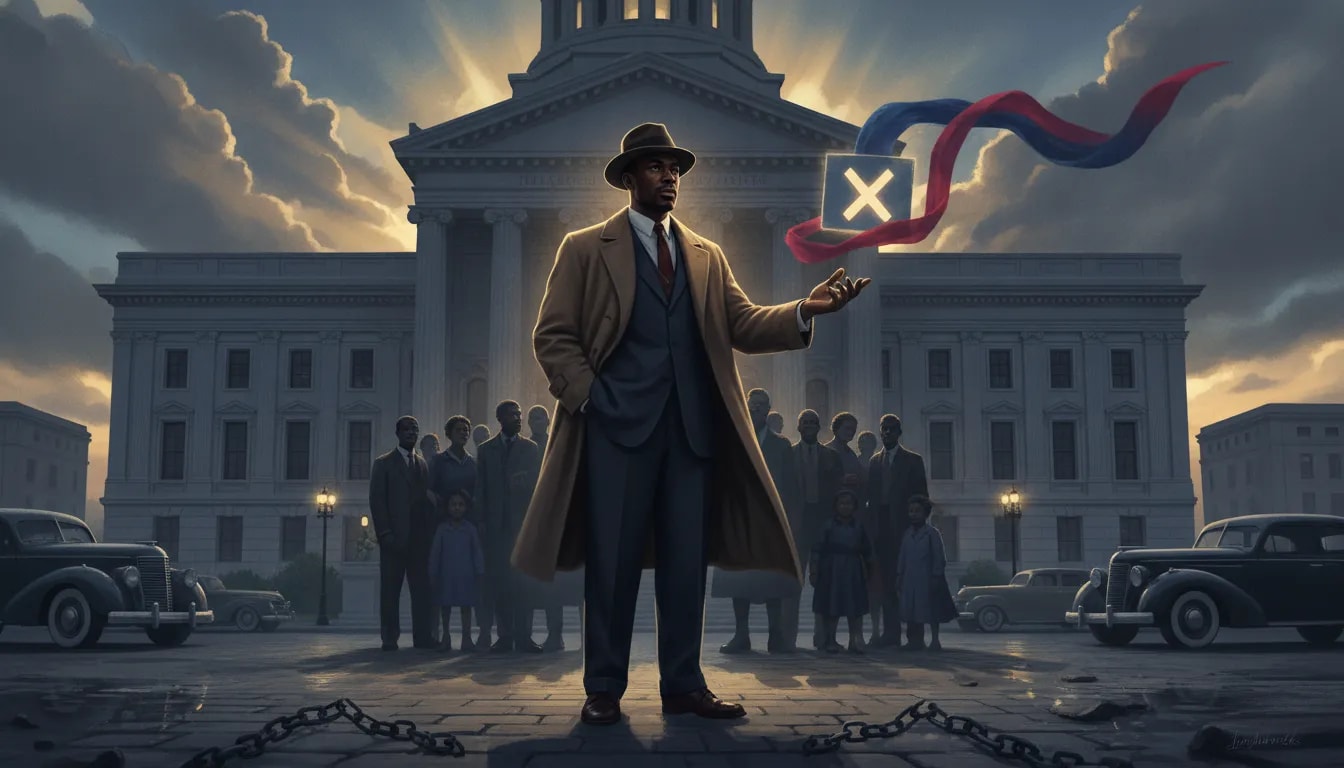
By Any Means begins with the murder of a real civil rights leader, Vernon F. Dahmer Sr., and the lasting meaning of the life he gave in service to his community. This is not simply a story about a crime. It is a story about a man who believed that the right to vote was worth defending, even when defending it came at an unimaginable cost.
Vernon Dahmer was known as an honest, hardworking man whose store offered more than goods. It offered refuge. It was a place where people in the community could find help, safety, and someone willing to stand up when standing up carried real danger.
An Everyday Man Who Chose to Act
Dahmer’s legacy rests in an idea that is both plain and powerful: people deserve the power to shape their own future. At a time when Black Mississippians faced barriers designed to keep them from the ballot box, he decided to help remove one of those barriers by offering to pay poll taxes for people who could not afford them.
His conviction was clear. If people do not vote, they do not count. Voting was not an abstract political issue. It was a means of dignity, representation, protection, and change.
That commitment made Dahmer a target. Yet it also made him an enduring example of what courage can look like. He was not presented as a distant historical symbol. He was a family man, business owner, neighbor, and community leader who recognized that ordinary people can take extraordinary responsibility for one another.
Why the Fight for the Vote Mattered So Much
Poll taxes were among the tools used to deny Black Americans access to voting. By requiring payment before someone could cast a ballot, officials could exclude citizens with limited financial means while claiming the system was neutral. In practice, these restrictions were part of a wider effort to uphold racial inequality and political disenfranchisement.
Dahmer’s decision to cover poll taxes was therefore an act of practical resistance. He did not only urge people to participate. He helped make participation possible.
The struggle for voting rights in Mississippi and across the South required this kind of local action. National movements are built through people who organize in neighborhoods, churches, businesses, homes, and gathering places. The work becomes real when someone opens a door, provides resources, accepts risk, and tells others that their voice matters.
For broader historical context on the laws and organizing that shaped this era, the U.S. National Archives overview of the Voting Rights Act of 1965 offers a useful starting point.
A Family’s Memory of Vernon Dahmer
At the heart of this story is not only public history but family memory. Betty Dahmer, Vernon Dahmer’s daughter, speaks to the kind of man her father was and why his sacrifice continues to matter.
His goodness was rooted in action. He helped people. He wanted to be part of the change unfolding throughout the country. He understood that civil rights were not someone else’s responsibility, or an issue that could wait for safer circumstances.
That is what gives his legacy such force. Dahmer empowered people who had been told, through law and intimidation, that their participation did not matter. He answered that message with something stronger: it does matter, and it is worth protecting.
His family carries forward the reason he gave his life. The legacy is not defined only by the violence committed against him. It is defined by the values he lived for, the people he helped, and the insistence that Black citizens deserved the full rights of citizenship.
From Civil Rights Murder to a Federal Investigation
The murder of Vernon Dahmer sets the action of By Any Means in motion. The film follows a young Black FBI agent sent into 1960s Mississippi to investigate a wave of brutal killings targeting civil rights leaders.
The investigation is shaped by silence, fear, and the difficulty of seeking justice in a place where people are reluctant to speak with federal authorities. Few are willing to cooperate freely. That pressure pushes the case beyond ordinary investigative boundaries.
The agent is forced into an uneasy partnership with Greg Scarpa, a notorious mafia hitman. They are divided by background, methods, and morality, but tied together by the need to find those responsible. Their shared mission creates the central tension of the film: when institutions fail the people they are supposed to protect, where do the limits of the law stand?
By Any Means does not frame justice as simple. It places justice and vengeance dangerously close together. The pursuit of accountability becomes more urgent because the crimes are not isolated. They are part of a campaign intended to terrorize those demanding civil rights.
The Cost of Refusing to Be Intimidated
Vernon Dahmer knew the risks of his work. Supporting voting rights in that environment was not a symbolic gesture. It could place a person, their family, and their community in immediate danger.
That is why his story carries such emotional weight. He paid a price for believing that people should be able to vote. But the attempt to silence him did not erase what he stood for. It revealed why his work was necessary.
The image of Dahmer as an “every man” is essential. His heroism was not based on celebrity or official power. It came from a choice to use what he had, including his business, his resources, and his standing in the community, to help other people claim a right that should never have been withheld.
That kind of courage is contagious. When one person takes a stand, others see that participation is possible. When a community realizes it has someone willing to support it, fear no longer has the same power.
What By Any Means Preserves
The purpose of telling Vernon Dahmer’s story is not to reduce him to the catalyst for a thriller. It is to help ensure that people understand who he was and what he stood for.
His life speaks to the enduring connection between civic participation and personal courage. The ballot remains a measure of whether a democracy recognizes its people. Dahmer understood that reality in the clearest possible terms, long before the protections many now take for granted were secured.
His message remains direct:
- Political participation matters.
- Communities need people who are willing to help others overcome barriers.
- Change often begins with practical acts of service.
- Justice requires more than words when people are being denied their rights.
By Any Means honors a legacy of courage, community, and commitment to change. Vernon Dahmer’s life reminds us that the people who transform history are not always those with the most power. Often, they are the ones who decide that the people around them matter enough to defend.
For film information and official updates, visit the By Any Means official website.
Frequently Asked Questions
Who was Vernon Dahmer?
Vernon F. Dahmer Sr. was a Mississippi civil rights leader, business owner, and community figure who supported Black voter participation. He was known for helping people in his community and for offering to pay poll taxes so more Black citizens could vote.
What is By Any Means about?
Inspired by a true story, By Any Means follows a young Black FBI agent investigating killings of civil rights leaders in 1960s Mississippi. The investigation is sparked by Vernon Dahmer’s murder and brings the agent into an uneasy partnership with mafia hitman Greg Scarpa.
Why did Vernon Dahmer help pay poll taxes?
Dahmer believed voting was essential to political power and equal citizenship. By helping people pay poll taxes, he worked to remove a financial barrier that prevented Black citizens from exercising their right to vote.
What does If you do not vote, you do not count mean?
The phrase expresses Dahmer’s belief that voting gives communities a voice in the decisions that affect their lives. It was a call to resist disenfranchisement and claim political representation.


