
I do not like being licked in the face. Yet when you are making a survival story with a dog at its center, personal boundaries get negotiated pretty quickly. You share the same bowl, eat the same stuff, get covered in fur and slobber, and somewhere in that daily routine, a real connection starts to form.
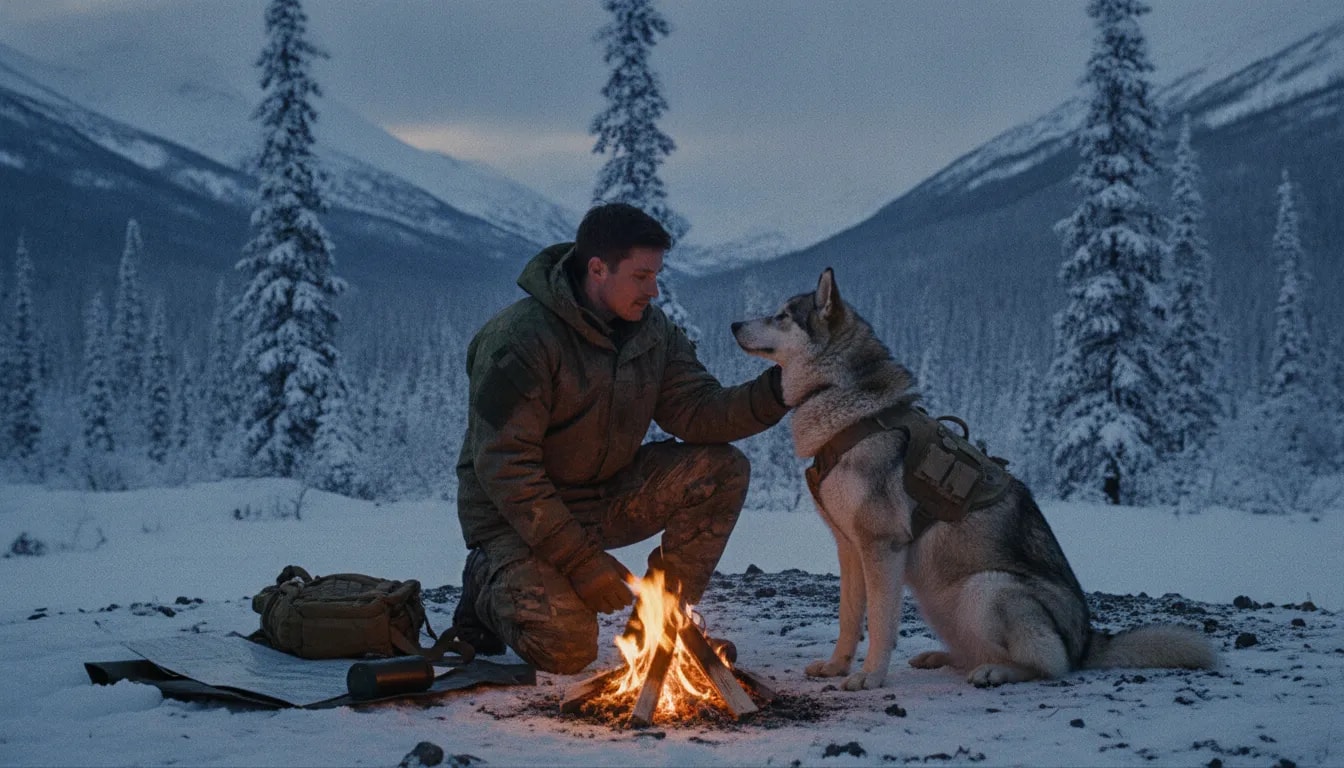
That connection is the heart of Heart of the Beast. After a plane crash strands Special Forces officer James Belmont and his combat dog, Odin, in the Alaskan wilderness, survival is no longer a solo mission. Man and dog must face the elements together, and the relationship has to feel lived-in from the first frame.
A Dog Is Not Just a Co-Star
In this film, the dog is not a background detail or a convenient companion. Odin is a full character in the story, with experience, instinct, loyalty, and a role in James Belmont’s fight to stay alive.
That meant the work went far beyond simply arriving on set and reacting to a trained animal. Brad Pitt had to become part actor, part dog trainer, building the kind of rapport that would make the relationship believable under pressure.
The production worked with animal coordinator Andrew Simpson and his team, who found Uber, the German Shepherd playing Odin. Uber brought something particularly meaningful to the role: he had done search-and-rescue work in his younger years.
Centering the film around a dog with that kind of real-world history gave the partnership extra weight. Odin is a combat dog in the story, and Uber arrived with a grounded, capable presence that made the character feel natural rather than manufactured.
Building Trust Day by Day
The bond did not come from one rehearsal or one big emotional scene. It came from repetition. Training happened day in and day out, including time in Uber’s kennel and time working through the film’s larger set pieces and choreography.
That is where the practical side of a human-and-dog partnership becomes clear. A dog does not memorize dialogue or hit a mark because the script says so. The work is about trust, timing, familiar routines, and finding a way to communicate when the day is long and the environment is busy.
Uber proved to be remarkably versatile. Whether the scene called for movement, focus, intimacy, or action, he brought the energy of a dog who was ready to work. He was great at everything because, frankly, he is a beast.
The Challenge of Acting Opposite a Dog
Dogs do not know their lines. They are just there being dogs.
That can be funny until the scene is carrying serious emotional weight. You might be in the middle of a heavy dramatic moment, fully inside the character’s fear or exhaustion, and suddenly your scene partner decides it is time to run off.
The solution is not glamorous. Keep treats close. Call him back. Get the reset. Then find your way immediately back into the emotion of the scene.
That quick shift is part of the job. One second, you are saying, “Uber, Uber, here, buddy.” The next, you are back in a story about survival, loss, duty, and one last mission. The dog keeps everybody honest because the moment has to stay responsive and alive.
Creating the Big Moments Together
Heart of the Beast places James and Odin in harsh wilderness conditions, where the terrain itself becomes an opponent. Their journey includes forests, rocky ground, cold water, steep obstacles, and the constant strain of trying to survive after catastrophe.
Those sequences require carefully planned choreography. The dog needs to know where to go, when to stop, how to respond, and how to work alongside actors and crew without losing the natural quality that makes the relationship convincing.
The goal is never for the dog to feel mechanical. Odin has to remain a dog with instincts and personality, even as he moves through a tightly coordinated production. That balance is what gives the action its force.
The Chemistry Cannot Be Faked
The most important part of the work was not a command, a stunt, or a perfectly timed entrance. It was the chemistry.
There is an immediate kind of affection that can develop when you spend enough time with a dog. It shows up in the small things: the attention, the eye contact, the way a dog settles beside you, the mutual recognition after another take.
That feeling became relentless and magical. It is difficult to manufacture because audiences recognize when the relationship is merely performed and when it has become real between two beings sharing the same space.
The bond between a person and a dog is undeniable. In Heart of the Beast, that truth is not separate from the survival story. It is the reason the story works. James and Odin are not simply trying to make it through the wilderness. They are trying to bring each other home.
Why Odin Matters to the Story
A survival thriller can be about endurance, strategy, and brute force. This one is also about companionship. James Belmont may have military training, but he is not meant to face the aftermath of the crash alone.
Odin brings more than protection. He brings purpose, loyalty, and another life that James has to care for when everything around them is trying to break them down. That responsibility changes the stakes.
The relationship works because neither one is simply saving the other. They become a unit. That is the emotional core of Heart of the Beast, directed by David Ayer and arriving in theaters September 25.
Frequently Asked Questions
Who plays the dog Odin in Heart of the Beast?
Odin is played by Uber, a German Shepherd with search-and-rescue experience from his younger years.
What is Heart of the Beast about?
The film follows Special Forces officer James Belmont and his combat dog, Odin, after a plane crash leaves them stranded in the Alaskan wilderness. Together, they must survive brutal conditions and fight their way through the elements.
How did Brad Pitt prepare to work with Uber?
He trained with Uber regularly, spent time in his kennel, worked with animal coordinator Andrew Simpson and his team, and rehearsed the set pieces and choreography needed for the film.
Why was Uber a strong fit for Odin?
Uber had a grounded personality and prior search-and-rescue experience, which gave the character a believable working-dog presence.


