
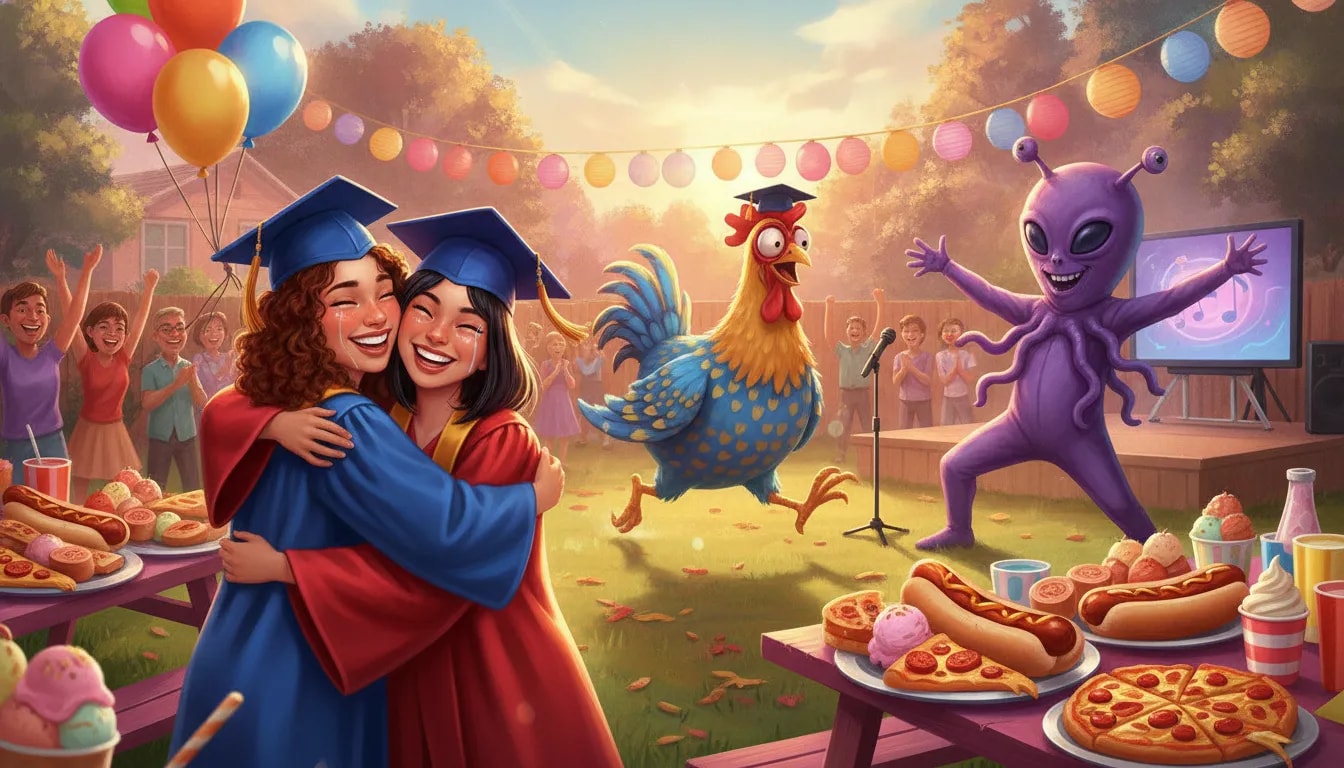
Graduation parties are supposed to be simple. You celebrate the smart kid. You eat too much food. Someone grabs a microphone for karaoke. Somebody’s aunt makes the whole thing louder, weirder, and much more memorable than planned.
Then, apparently, a giant chicken shows up.
The extended graduation clip from Forgotten Island introduces Raissa’s farewell celebration with the exact kind of chaotic, loving energy that only family can create. It begins as a proud sendoff for a brilliant young woman heading to Caltech, then turns into a full-blown neighborhood spectacle filled with karaoke, balloons, oversized food trays, an elaborate slideshow, and a costumed entrance nobody will ever forget.
Under all that comedy is the real heart of the story: two lifelong best friends, Jo and Raissa, are standing at the edge of a major change. Raissa is preparing to leave home for college. Jo is trying to make the most of their last night together. Their friendship is about to be tested in ways neither of them could predict.
Raissa’s Big Achievement Is the Reason for the Party
Everyone at the gathering knows exactly why they are there. Raissa is smart, accomplished, and headed to Caltech. Her family proudly talks up the school’s connection to NASA’s Jet Propulsion Laboratory, turning her next step into a community-wide victory.
That detail matters because it immediately tells us who Raissa is. She is not merely graduating. She has earned a future that feels huge, ambitious, and far beyond the familiar world of home. Caltech is known for its science and engineering programs, and its close relationship with the NASA Jet Propulsion Laboratory makes the dream sound even more cosmic.
For her family, that future is dazzling. There is pride in every exaggerated comment, every overly specific brag, and every awkward attempt to imagine what California will bring. Maybe Hollywood. Maybe movie stars. Maybe an introduction to Tom Cruise, because that is obviously how moving to California works.
It is affectionate nonsense, but it is also revealing. Nobody is downplaying Raissa’s success. They are shouting it from the rooftops, sometimes literally through a karaoke mic.
The banner says it all: congratulations, love, luck, and Caltech. It is handmade, heartfelt, a little loud, and completely appropriate for a party where subtlety was never invited.
A Farewell Party Where Everyone Has a Role
The celebration is packed with the kinds of people who make a party feel lived in. There are family members, neighbors, friends, kids, elders, karaoke regulars, and at least one person who seems ready to turn any moment into a performance.
Jo moves through the crowd looking for Raissa, which adds a nervous undercurrent to all the fun. The party is supposedly for Raissa, but Jo cannot settle into the festivities until she finds her best friend. That tiny mission says a lot about their relationship. Even in a crowd full of people cheering Raissa on, Jo’s first instinct is to locate the person who matters most to her.
Meanwhile, the party keeps producing distractions.
- Kids demand a scary story and insist they will not be frightened this time.
- A dramatic horror tale somehow begins with an empty crib and ends with a very apologetic storyteller.
- Relatives trade compliments that become jokes halfway through the sentence.
- Someone compares Raissa to a beautiful walking calculator.
- Karaoke gets treated with the seriousness of a stadium concert.
This is the comedy of people who know each other too well. They tease because they care. They embarrass because it is their love language. They gather because a major life moment should not be carried alone.
The opening sentiment captures that spirit beautifully: celebrate the people who make us laugh hardest, embarrass us most, and show up when it matters. That is exactly the emotional equation of this party. It is loud, messy, occasionally mortifying, and undeniably full of love.
Jo’s Giant Chicken Entrance Changes the Temperature of the Room
Just when the farewell celebration seems like it has reached maximum chaos, Jo arrives in a giant chicken costume.
Not a tasteful chicken costume. Not a costume that blends into the background. This is a bright yellow, oversized, giant-eyed chicken with Jo’s face visible inside the beak. It is the kind of entrance that announces, “I have made a choice, and now everybody has to deal with it.”
There is a useful emotional logic behind the absurdity. Raissa is leaving. The future is approaching. Everyone is getting sentimental. So Jo’s answer is to bring giant chicken energy to the party.
That is what a best friend does when words are hard. You make a fool of yourself. You arrive in something ridiculous. You redirect the tension. You give everyone a reason to laugh when they are all trying not to cry.
The chicken costume is comedy, but it is also protection. Jo can hide in it while still making the biggest possible gesture. She can be the center of attention without admitting how deeply she feels the coming goodbye.
And of course, it works. The party notices.
Food, Faith, Karaoke, and an Extremely Public Celebration
The visual world of the party is wonderfully specific. Bright balloons stretch through the outdoor space. Red umbrellas shade tables. Decorative banners and colorful bunting fill the background. Food is everywhere, arranged in generous trays that make it clear nobody is leaving hungry.
A large roast pig anchors one of the food tables, surrounded by dishes and desserts. Nearby, a portrait of Jesus hangs above the spread. The image is funny because the party is already operating at maximum volume, yet it also gives the setting warmth and familiarity. The celebration is not built from generic decorations. It feels rooted in a home, a neighborhood, and a family rhythm.
Then there is the karaoke setup, which may be the true command center of the event.
The host treats the microphone like it has been handed down by destiny. A monitor displays lyrics in large type. The song builds. The crowd responds. Every gesture becomes bigger than it needs to be, because in karaoke, bigger is exactly the point.
The host’s performance moves from emotional singing to grand posing to full audience participation. When the screen reaches the word “LOVE,” the moment becomes hilariously sincere. The whole party gets swept into the feeling.
That is the charm of a big family party. There is no clean separation between spectacle and emotion. The same people who are making jokes about celebrities are also genuinely moved by Raissa’s departure. The same crowd that claps along to karaoke will absolutely cry during a slideshow.
The Slideshow Is Where the Feelings Catch Up
Every major family event has a point where somebody announces a slideshow, and suddenly everyone understands that emotional safety is over.
Raissa’s father introduces hers with a mixture of pride and barely contained sadness. He tries to keep the mood light, but it is clear that tomorrow changes everything. His daughter will be on her way to America, far from home, beginning a future he is deeply proud of and not entirely ready for.
That is the push and pull at the center of the celebration. Raissa’s family wants her to leave because she has earned this opportunity. They also want time to slow down because she is theirs.
The slideshow begins with a baby photo labeled “Our Baby Girl Raissa.” It is sweet, embarrassing, and exactly the sort of thing a parent would proudly project in front of an entire crowd. Raissa’s reaction makes the moment even better. She is caught between appreciation and horror. She knows the love behind it. She also knows everybody is now seeing baby pictures.
For Jo, though, the slideshow seems to land differently. The party keeps framing Raissa as the person who is leaving, the genius headed toward a dazzling future. That makes the distance between their paths feel more real, even before either of them says it out loud.
Friendships do not always drift apart because someone stops caring. Sometimes life simply begins pulling in two directions. A new school, a new city, a new country, a new set of expectations. The distance starts as a practical fact, but emotionally it can feel like a door slowly closing.
The Party’s Comedy Hides Real Fear About Growing Apart
Forgotten Island is built around Jo and Raissa, best friends since grade school, approaching a turning point. The graduation party makes that premise immediate. Before there is a portal, a magical island, or a mythological threat, there is a very familiar fear: what happens when your best friend’s life starts somewhere else?
Raissa’s future has a name, a destination, and a launch date. She is going to Caltech. She is leaving tomorrow. Her family can say it out loud because saying it is part of celebrating her.
Jo’s future, at least in this moment, is harder to read. Her giant chicken costume is an interruption, a performance, and perhaps a plea for the party not to move on too quickly. If everything stays funny, maybe nobody has to acknowledge the hard part.
The clip never needs to spell that out in a heavy-handed way. The emotion is already present in the contrast between Jo’s chaos and Raissa’s poised discomfort. Raissa stands at the center of attention while trying to survive the attention. Jo keeps generating bigger and stranger moments from the edges of the party.
Both reactions make sense. One friend is being celebrated into the future. The other is trying to hold onto the present.
A Scary Story Starts to Feel Less Like a Joke
Early in the party, children ask for another scary story. The story turns abruptly gruesome, involving an empty baby crib and blood left behind. It is played for a laugh because the person telling it immediately realizes they have gone way too far for this audience.
But that quick horror beat does more than provide a joke. It hints at the larger world waiting outside the party.
Jo and Raissa eventually stumble onto a mysterious portal that sends them to Nakali, a fantastical island filled with magical and mythological creatures from the stories they grew up hearing from their Filipino families. The bright, grounded celebration is therefore the emotional home base before the story moves into something stranger and more dangerous.
That blend of family comedy and folklore is central to the film’s setup. Mythological figures are not presented as random fantasy creatures dropped into the plot. They are tied to stories, memories, and cultural history passed through families.
On Nakali, some creatures become allies and others become threats. Jo and Raissa are joined by Raww, a well-meaning but hapless weredog, along with a small group of companions. Their greatest danger is the Dreaded Manananggal, the island’s most feared creature.
The stakes are not just about getting home. Jo and Raissa learn that the memories of their friendship are the price of returning. They have to find another way out before they forget each other forever.
That makes the graduation party feel even more important. It is not merely the last normal night before an adventure. It is a night full of shared references, old jokes, embarrassing relatives, food, songs, photos, and the very memories that define where these friends came from.
When the Giant Chicken Meets the Food Table
Jo’s costume adventure does not stop at the entrance. The giant chicken ends up near the buffet, where enthusiasm and balance prove to be a dangerous combination.
A dramatic food-table disaster follows. Trays rattle. Flames burst. Smoke rolls across the party. The event goes from heartfelt graduation celebration to full emergency in seconds.
It is a perfect escalation because the party has been walking that line all along. Everything is joyful, but everything is also one bad karaoke note away from total mayhem. Jo’s chicken costume is already a walking disaster magnet. Put it near a sprawling buffet and an open flame, and suddenly the farewell party has its own action sequence.
The people around Jo react with a mix of shock, alarm, and the exhausted expression of relatives who have seen enough nonsense to know that this is somehow going to get worse.
Yet Jo is still trying. Her messiness is not malicious. The grand gesture may be going spectacularly wrong, but it comes from a place of wanting to make the night meaningful, memorable, and impossible to forget.
Why the Filipino Family Setting Matters
The graduation clip has a distinct sense of place. The details are not treated as background decoration. They define the humor, the warmth, and the emotional stakes of the moment.
The party includes Filipino family dynamics, public karaoke, generous food, teasing relatives, celebratory banners, and folklore references that will become increasingly important once Jo and Raissa reach Nakali. All of it gives the story a specific texture.
That specificity is powerful because friendship is never experienced in a vacuum. Jo and Raissa’s bond has been shaped by the people around them, by the stories they heard growing up, by the celebrations they attended, and by the language of care their families share.
It also means that Raissa’s departure is not just about leaving a friend. She is stepping away from a whole ecosystem of familiar people and rituals. The party is trying to send her off with enough love, food, noise, and public embarrassment to last the distance.
And that is why the event can be silly and moving at the same time. A family does not always know how to say, “We will miss you.” Sometimes it says it through a giant banner. Sometimes it says it through an off-key ballad. Sometimes it says it by projecting a baby photo in front of everybody.
The Heart of Forgotten Island Is a Friendship Worth Fighting For
The party gives us a clear picture of what Jo and Raissa stand to lose. They are not simply two characters assigned to a fantasy quest. They are lifelong best friends with a shared past, a looming separation, and a relationship strong enough to survive embarrassment, chaos, and probably a giant chicken costume.
Once they reach Nakali, the story turns that emotional anxiety into a literal challenge. The possibility of growing apart becomes the possibility of forgetting each other completely. Their memories, history, and connection become something they must actively protect.
That is a sharp fantasy premise because it makes emotional stakes tangible. Everybody understands the fear of becoming strangers to someone who used to know you best. Forgotten Island takes that fear and gives it monsters, portals, mythological creatures, and a ticking clock.
The graduation clip is funny because its characters love each other with zero chill. It is moving because that love is about to be tested. Raissa is ready to pursue a future she has worked hard for. Jo is not ready to let their friendship become a memory. Somewhere between the slideshow, the karaoke concert, and the flaming buffet, the story’s real question takes shape.
Can two best friends move toward different futures without losing the past that made them who they are?
A Farewell That Refuses to Be Quiet
There is something wonderfully honest about a graduation party that cannot behave itself. Raissa’s celebration is not polished. It is crowded, noisy, sentimental, slightly chaotic, and occasionally on fire. But that is why it feels real.
The people around Raissa are not offering a formal sendoff. They are giving her all of themselves: their jokes, their singing, their pride, their bad timing, their food, their applause, and their tears.
Jo’s giant chicken stunt fits right into that world. It is ridiculous, yes. But it is also a declaration. Raissa is leaving, and Jo is going to make sure this last night together is unforgettable.
That becomes especially meaningful once the larger adventure begins. On Forgotten Island, remembering each other may be the one thing that matters most.
Forgotten Island arrives in theaters September 25. More details are available at the official Forgotten Island site.
Forgotten Island Graduation Clip FAQ
Why is Raissa being celebrated in the graduation clip?
Raissa has graduated and is preparing to leave for Caltech. Her family and community throw a large farewell party to celebrate her academic achievement and wish her luck as she begins a new chapter away from home.
Why does Jo wear a giant chicken costume?
Jo arrives in an oversized chicken costume as a huge, silly party gesture. The costume brings comedy to an increasingly emotional farewell and reflects Jo’s chaotic, affectionate way of showing up for Raissa.
What is Forgotten Island about?
Forgotten Island follows lifelong best friends Jo and Raissa after they discover a portal to Nakali, a fantastical island populated by magical and mythological creatures connected to Filipino family stories. To return home, they must confront a terrible cost involving the memories of their friendship.
Who are the main friends in Forgotten Island?
The central friendship is between Jo and Raissa, high school graduates who have been best friends since grade school but are about to begin separate life paths.
When does Forgotten Island arrive in theaters?
Forgotten Island is scheduled to arrive in theaters September 25.


