
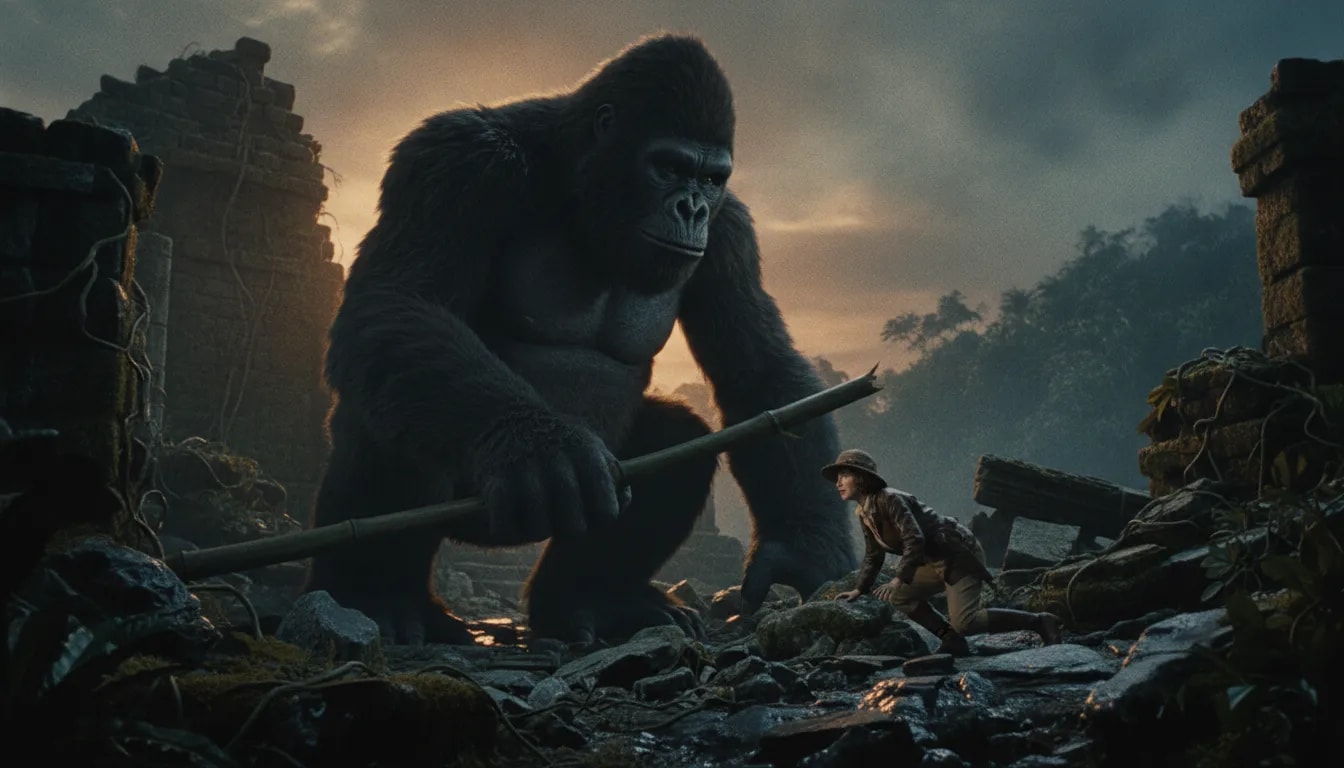
On Skull Island, survival depends on recognizing danger quickly. Ann Darrow knows that better than anyone. She has been carried through impossible terrain by a creature large enough to crush her without effort, and every instinct tells her to run the first moment she can.
Then something unexpected happens.
As Kong settles into the ruins and toys with a piece of bamboo, Ann finds a narrow chance to slip away. It is not a grand escape plan. It is desperate, improvised, and entirely human. She crawls through the rocks, keeps low, and tries to make herself small in a place where nothing about her is small to Kong.
But Kong notices. He always notices.
What follows is one of the defining moments in Peter Jackson’s King Kong: not a battle, not a chase for the sake of spectacle, but a strange encounter in which fear turns into communication. Ann cannot overpower Kong. She cannot reason with him in words. So she does the one thing she knows how to do. She performs.
Her dance begins as a survival tactic. It becomes something more revealing for both of them.
A fragile escape through Kong’s world
Ann’s attempt to get away begins in the most precarious possible setting. She is trapped among steep rock walls, tangled roots, moss-covered ruins, and narrow ledges. The island itself feels alive, crowded with places to fall, hide, or be cornered.

Kong is nearby, enormous even when sitting still. His scale transforms every ordinary object into something unfamiliar. A stalk of bamboo becomes a toy in his hands. A small rocky passage becomes a route that only Ann can use. The difference in size between them is never allowed to disappear.
That contrast is crucial. Ann is not escaping because she suddenly feels safe. She is escaping because there may never be another opening.
At first, Kong appears distracted. He examines the bamboo with a mixture of curiosity and irritation, snapping it apart and testing it like an object that has failed to entertain him. Ann uses those seconds to pull herself away across the earth and stones.
The scene makes her vulnerability unmistakable. She is exhausted, dirty, and frightened, moving through a landscape that has already threatened her at every turn. There is no triumphant music of freedom. There is only the difficult sound of scrambling over loose ground while a giant presence looms behind her.
Kong’s reaction changes the entire mood. He does not simply lose sight of her. He realizes she is leaving him.
That distinction matters. A conventional monster might pursue prey with a single-minded hunger. Kong’s pursuit has anger in it, but it also carries frustration and confusion. Ann has become significant to him, though neither of them has a language for what that significance means.
Fear is the starting point, not the whole relationship
At this stage, Ann has every reason to see Kong as pure danger. He has taken her from the village and carried her into a world where she has no control over anything. Even when he keeps her from more immediate threats, his protection does not erase the terror of being in his grasp.
Kong, meanwhile, remains volatile. His expressions shift from irritation to rage in a heartbeat. He bares his teeth, pounds across the ground, and closes the distance with frightening ease. The rocky plateau becomes a stage for a pursuit in which Ann has nowhere reliable to go.
Yet the point of the sequence is that sheer force is not the whole truth about him.
Kong is powerful enough to dominate the space completely, but he does not treat Ann as a meaningless object. His attention lingers on her. He studies her reactions. He responds when she changes her behavior. That capacity to respond, rather than merely destroy, is what gives the scene its emotional charge.
Ann recognizes this before she fully understands it. Her fear does not vanish. It evolves into a risky calculation: if Kong is paying attention, perhaps she can direct that attention somewhere other than her attempted escape.
It is a terrible gamble, but it is the only kind of leverage she has.
The performer returns when words fail
Ann Darrow is an actress. Earlier in her life, performance was a way to earn a living, charm an audience, and create a small bit of magic out of almost nothing. On Skull Island, those skills become more than professional tools. They become a means of survival.
When Kong corners her, Ann begins with a hesitant burst of movement. She throws her arms wide, skips, turns, and makes exaggerated gestures. It is not a polished routine in a theater. It is physical comedy stripped to its essentials, made up in the moment under impossible pressure.
She looks ridiculous because she has to.
That is what makes the moment brave. Ann does not wait until she feels composed. She performs while terrified. Her body is tense, her breathing is uneven, and every movement risks provoking the creature towering over her. Still, she commits to the bit.
She dances because stillness has failed. Running has failed. Pleading has failed. A performance is the one unexpected thing she can offer.
The dance is deliberately broad. Ann twirls, kicks, strikes silly poses, and fills the open space with movement. Her gestures are theatrical enough to read from a distance, which is exactly what the moment needs. Kong cannot understand her words, but he can understand that she is doing something for him.
There is an important difference between Ann surrendering and Ann performing. Surrender would make her passive. The dance makes her active. She is still vulnerable, but she is shaping the encounter instead of simply enduring it.
That is one reason the scene remains so memorable. Ann does not tame Kong through force or sentimentality. She reaches him through imagination.
Kong’s rage begins to give way
At first, Kong reacts with impatience. He roars. He looks ready to charge. The dance seems so absurd against his anger that it could easily make things worse.
Then he pauses.
The pause is everything.
Kong begins to look at Ann differently. The aggression does not disappear all at once. His face remains severe, and his body is still coiled with power. But curiosity breaks through the rage. He follows her gestures. He watches her movement rather than simply pursuing her.
This is where the scene moves beyond a simple escape attempt. Ann discovers that Kong can be distracted by play. More importantly, she discovers that he can be reached by it.
The visual effects work has to carry a tremendous amount of this emotional shift. Kong cannot speak, so his eyes, brow, mouth, posture, and small changes in attention must communicate the movement from fury to fascination. The performance gives him animal weight and unpredictability, but it also gives him thoughtfulness.
His face does not become soft in a human way. That would weaken the character. He remains imposing, restless, and difficult to read. But he is no longer only reacting. He is observing.
Ann sees the change and keeps going.
She leans into the comedy, swinging her arms and exaggerating her steps. She makes a spectacle of herself, and Kong responds not with another immediate attack but with attention. It is the first small bridge between them.
Why the dance works
The scene works because it never pretends that Ann and Kong are equals in power. They are not. Kong could end the encounter at any moment. Ann’s dance is meaningful precisely because she chooses creativity in a situation built on imbalance and fear.
It also works because the performance is not calculated perfection. Ann is improvising. Her movements are clumsy, playful, and a little desperate. Kong does not need technical grace. He needs something that breaks the cycle of pursuit, panic, and anger.
The dance gives him that break.
It offers movement without threat. It turns Ann from someone fleeing him into someone doing something strange specifically in front of him. His attention is redirected from possession to curiosity.
In a few minutes, the scene establishes several truths:
- Ann is resourceful. She uses the talent she has, rather than wishing for power she does not possess.
- Kong is more than brute force. He has anger and violence in him, but also boredom, curiosity, recognition, and the capacity to be moved.
- Communication does not require shared language. Gesture, rhythm, expression, and attention can create a connection when words cannot.
- Comedy can interrupt terror. Ann’s physical humor changes the emotional rules of the encounter without denying the danger.
- The relationship is built on response. Ann acts, Kong reacts, and then Ann adjusts. Their bond begins as an exchange.
This is not a story about a woman making a monster harmless. Kong remains dangerous from beginning to end. Instead, it is a story about a woman discovering that a creature everyone assumes is only a monster has an inner life that cannot be reduced to violence.
The landscape makes their connection feel impossible
The location does a great deal of storytelling. The cliffs of Skull Island seem to hang between jungle and ocean, with waterfalls cutting through walls of ancient stone. Greenery spills over the rocks, but the terrain is harsh and broken. It is beautiful, but never welcoming.
Against that vast setting, Ann and Kong look almost unreal together. She is a small figure in a pale dress, framed by open sky and the distant sea. Kong is dark, massive, and rooted in the landscape as if he belongs to the island itself.
The environment reinforces the emotional distance between them. They are standing only a few yards apart, but they come from utterly different worlds. Ann carries the instincts of a performer from New York. Kong is the dominant creature of an isolated island, shaped by a brutal environment and a lifetime without anyone like her.
The dance creates a temporary common ground in that impossible space.
For Ann, it is an act from the world she knows. For Kong, it is a new kind of behavior that catches his attention. The cliffside becomes a stage, not because it is safe, but because Ann makes it one.
Naomi Watts makes the fear believable
Ann’s dance would not matter if it felt detached from danger. Naomi Watts keeps the fear present in every beat. Ann does not suddenly become carefree. Even as she makes Kong pause, she is searching his face for the slightest sign that the plan has failed.
That balance is what keeps the scene from becoming a novelty. The comedy is genuine, but it is never weightless. Ann knows that Kong could roar, lunge, or grab her at any second. Every silly step is also an act of nerve.
Her body language changes as the moment continues. At first, the movement is a defensive distraction. Then, as Kong watches instead of attacking, she begins to find more confidence. She turns the performance outward. She moves with more rhythm. She allows herself to believe, briefly, that it may be working.
But she does not forget where she is.
The moment she senses the threat returning, that confidence tightens again. This is not a charming animal trick. It is a perilous negotiation carried out through movement.
That tension gives the scene its pulse. The dance makes Kong more understandable, but it does not make him predictable.
Andy Serkis gives Kong a mind behind the roar
Kong’s reaction is just as important as Ann’s performance. He does not become human, and he does not suddenly understand comedy in the way Ann does. His response is subtler than that.
He is intrigued by what he cannot categorize.
For a creature accustomed to physical dominance, Ann’s dancing is a strange display of energy with no obvious challenge behind it. She is not attacking. She is not fleeing, at least not in that moment. She is making a pattern out of her body and asking him, in effect, to pay attention.
Kong does.
The smallest shifts in his face communicate the change. His roars become less like immediate aggression and more like emotional release. His head tilts. His eyes track her. The huge physical presence remains, but the scene gives him a private, almost childlike curiosity without making him childish.
That complexity is central to Peter Jackson’s version of King Kong. The spectacle is enormous, with dangerous creatures, towering cliffs, and breathtaking Skull Island vistas, but the emotional center depends on whether Kong feels like a character rather than an effect.
Here, he does. The anger in his face is real. So is the growing attention.
A connection that does not erase the danger
Ann’s dance calms Kong, but it does not solve everything. She is still trapped on Skull Island. He is still a massive, volatile creature capable of terrifying violence. Any peace between them is fragile.
That fragility is the scene’s point.
The encounter is not built on safety. It is built on recognition. Ann realizes that Kong has feelings beyond rage. Kong begins to recognize Ann as more than something to seize or protect. She becomes a distinct person to him, someone who can surprise him.
Their connection begins in the gap between those realizations.
There is an emotional honesty to this sequence that makes it stand apart from the film’s larger action. No one explains what is happening. No one translates the moment into neat language. Ann and Kong simply respond to each other until fear gives way, briefly, to curiosity.
That is why the dancing matters. It is not a pause from the story. It is the story.
The strange power of performance
Ann’s dance is a reminder that performance can be much more than entertainment. In the right moment, it can be a way of reaching across fear, difference, and isolation.
She cannot speak Kong’s language. She cannot defeat him. She cannot make Skull Island safe. But she can create a moment that is unexpected enough to stop him from seeing her only as something that belongs to him.
There is real courage in that.
The scene also gives Ann a form of agency that fits who she is. She does not become a fighter merely because the story is dangerous. She survives by using humor, instinct, vulnerability, and theatrical invention. Those are not lesser tools. In this encounter, they are the only tools that work.
For Kong, the dance opens a crack in the image everyone else has of him. He is terrifying. He is immensely strong. He is also lonely, curious, and capable of being captivated by something gentle and strange.
That combination is the tragedy at the heart of King Kong. The world sees the monster first. Ann sees the creature behind the roar.
For a few moments on a cliff above the ocean, with the island stretching out behind them, a dance makes that difference visible.
Where this moment fits in Peter Jackson’s King Kong
Released in 2005, Peter Jackson’s King Kong reimagines the classic story as an epic adventure built around Skull Island, its dangerous wildlife, and the relationship between Ann Darrow and Kong. The film stars Naomi Watts as Ann, Jack Black as filmmaker Carl Denham, Adrien Brody as playwright Jack Driscoll, and Andy Serkis as Kong.
The dance sequence captures the film’s unusual balance. It is suspenseful, funny, visually grand, and deeply sad all at once. It gives the massive digital creation at its center a recognizable emotional life without reducing the danger he represents.
For more background on the film, visit Universal Pictures Home Entertainment’s King Kong page. For broader context on Peter Jackson’s filmmaking, the Encyclopaedia Britannica profile of Peter Jackson offers an overview of his career.
But this one scene makes its own case for why the film endures. In the middle of a terrifying island, Ann refuses to be only afraid. She performs. Kong pauses. And for the first time, the distance between them becomes just a little smaller.


