
A man. A plan. A meltdown. DIGGER is a disaster movie with the volume turned all the way up, and its central figure does not exactly respond to catastrophe with humility.
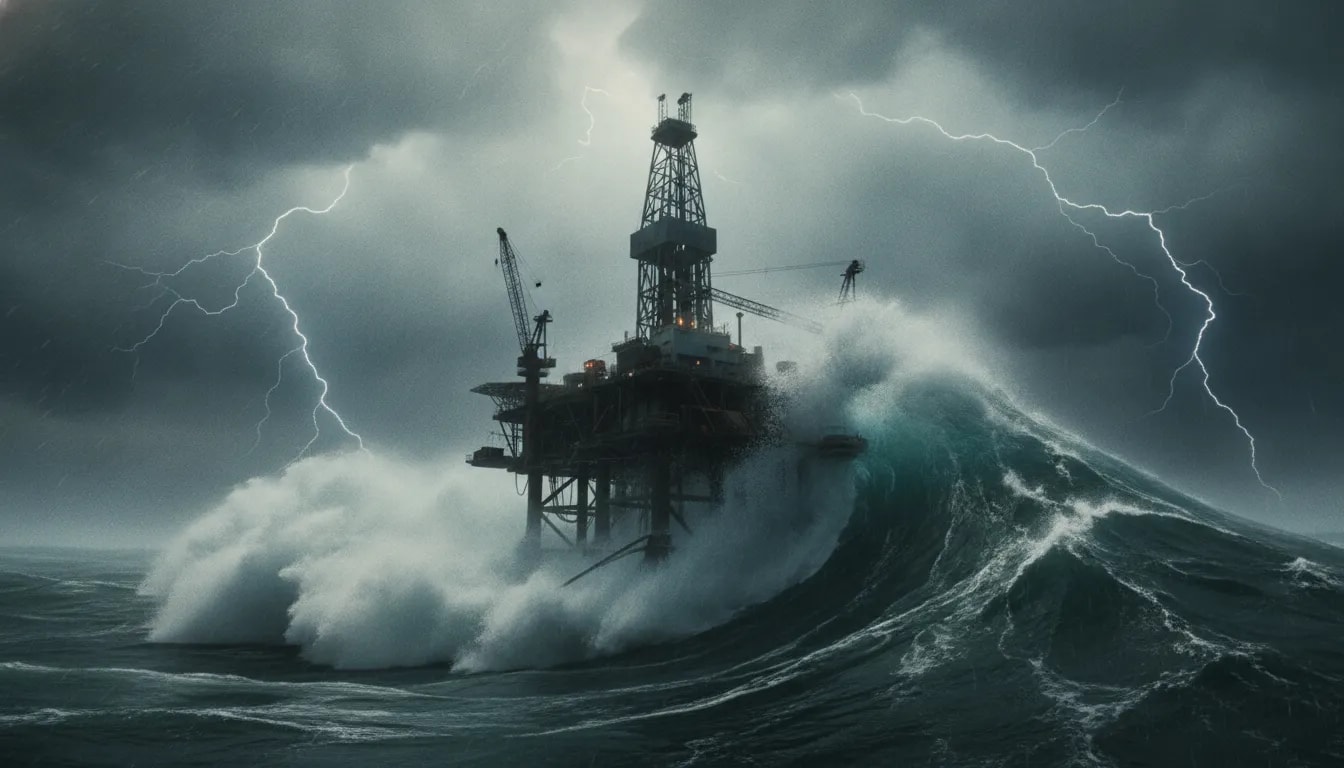
Tom Cruise plays Digger Rockwell, an immensely powerful drilling magnate who finds himself at the center of an unimaginable crisis. An explosion on one of his rigs causes massive water displacement and triggers a tsunami. Early casualty estimates are already in the hundreds of thousands. The scale is apocalyptic. The response from Rockwell is even bigger.
Rather than retreating from the fallout, he insists that the person who got the world into this mess is the only person capable of getting it out. It is an outrageous promise, delivered with the total conviction of a man who has spent his life making the impossible sound inevitable.
A Savior Complex Meets a Global Catastrophe
The pressure on Digger Rockwell is immediate and brutal. He knows the public sees him as the villain, a corporate titan whose drilling operation has drowned an enormous stretch of land. He anticipates the fury, the accusations, and the possibility that people would happily see him punished for what has happened.
But Digger has a defense ready. Stop drilling, he argues, and people starve. They freeze. His industry, in his view, is not merely profitable. It is indispensable. That logic becomes the foundation for his desperate campaign to retain power and take control of the response.
The film’s central question is not simply whether Digger can prevent further destruction. It is whether a man defined by ego, wealth, and denial can genuinely become humanity’s savior, or whether his attempt to fix the disaster will unleash something worse.
Power, Deniability, and a Man Who Will Not Back Down
DIGGER plays its premise with a wickedly comic edge. The people surrounding Rockwell are caught between horror and absurdity as the crisis accelerates. Boardrooms, military briefings, political chambers, and private offices become stages for grandiose declarations and reckless solutions.
One title card captures the film’s attitude perfectly: power does not always bring responsibility. Sometimes, it brings deniability.
That is the nerve DIGGER keeps pressing. Digger does not present himself as a monster. He presents himself as a realist. He sees the dependency the world has built around his industry, then uses that dependency to justify almost anything. His confidence is magnetic, horrifying, and frequently hilarious.
Even when facing a disaster on a continental scale, the instinct is to double down. To dominate the room. To manage the narrative. To find a weapon, a scheme, or a spectacle big enough to make everyone believe he remains in control.
The Escalation Goes From Crisis Management to Madness
The situation is already extraordinary before the proposed solutions arrive. There are military officials, maps, screens showing the unfolding catastrophe, crowded halls of power, and a frantic scramble to decide who gets to make the next catastrophic call.
Digger’s response is not cautious diplomacy. It is action at any cost. The language of a rescue mission quickly becomes the language of escalation, including talk of using overwhelming military force against a threat that appears far larger and stranger than anyone can comprehend.
The contrast is the point. A global disaster demands restraint, competence, and moral clarity. Digger answers with bravado, salesmanship, and the kind of confidence that makes everyone else in the room wonder whether he has finally gone too far.
- The disaster: A drilling-rig explosion triggers massive displacement and a tsunami with catastrophic casualties.
- The public reckoning: Rockwell faces blame from people who view him as personally responsible for the devastation.
- The defense: He argues that the world cannot survive without the energy and systems his business represents.
- The mission: He claims he can save humanity, even as his decisions appear to push events toward greater chaos.
- The tone: Political satire, catastrophe spectacle, and dark comedy collide in the same high-pressure rooms.
An Ensemble Built for a High-Stakes Collision
Cruise leads a formidable cast that includes Riz Ahmed, John Goodman, Sandra Hüller, Michael Stuhlbarg, and Jesse Plemons. Their characters surround Digger at the exact moment when loyalty, expertise, fear, and self-preservation all start competing for space.
That ensemble matters because Digger’s confidence needs resistance. His declarations become funnier and more unnerving when delivered to military leaders, advisers, officials, and insiders who look like they have just realized the fate of the world may rest with the least reliable man in the room.
A Disaster Film With Alejandro G. Iñárritu’s Bite
Directed by Alejandro G. Iñárritu, DIGGER brings an aggressively stylized visual world to its story of wealth, political power, environmental catastrophe, and ego. The film moves between monumental public spaces, lavish private rooms, chaotic command centers, turbulent water, and images of a world coming apart.
The result looks deliberately excessive because Digger himself is excessive. He makes grand entrances, commands attention, and behaves as if every room belongs to him. Even his effort to restore order feels like another performance, one that might be heroic if it were not so dangerous.
The film is shot entirely in VistaVision and is designed for a large-format experience. For theater availability and format details, IMAX’s official site provides current information by location.
Why DIGGER’s Premise Lands
There is something especially sharp about a story in which the person who caused the catastrophe is also the person demanding the authority to solve it. That contradiction is where DIGGER finds its energy.
Digger Rockwell is not asking to be forgiven. He is asking to be trusted, perhaps because he sees no meaningful difference between the two. His ambition to become humanity’s savior is inseparable from his need to remain the most powerful man in the world.
That makes the coming meltdown feel both enormous and deeply personal. The tsunami may be global, but the real collision is between a man’s self-image and the consequences he can no longer outrun.
Release Date and Format
DIGGER arrives in theaters and IMAX across North America on October 2, 2026, with international release beginning September 30, 2026.
It promises a wildly scaled story about the cost of unchecked power, delivered with a grin, a disaster siren, and one man’s absolute certainty that he can dig the world out of the hole he made.
Frequently Asked Questions About DIGGER
What is DIGGER about?
DIGGER follows Digger Rockwell, a powerful drilling magnate whose rig explosion triggers a devastating tsunami. As blame mounts, he launches a frantic effort to prove that he can save humanity from the disaster he helped create.
Who stars in DIGGER?
Tom Cruise stars as Digger Rockwell. The cast also includes Riz Ahmed, John Goodman, Sandra Hüller, Michael Stuhlbarg, and Jesse Plemons.
Who directed DIGGER?
DIGGER is directed by Alejandro G. Iñárritu.
When does DIGGER arrive in theaters?
The film opens in theaters and IMAX across North America on October 2, 2026. International release begins September 30, 2026.


