
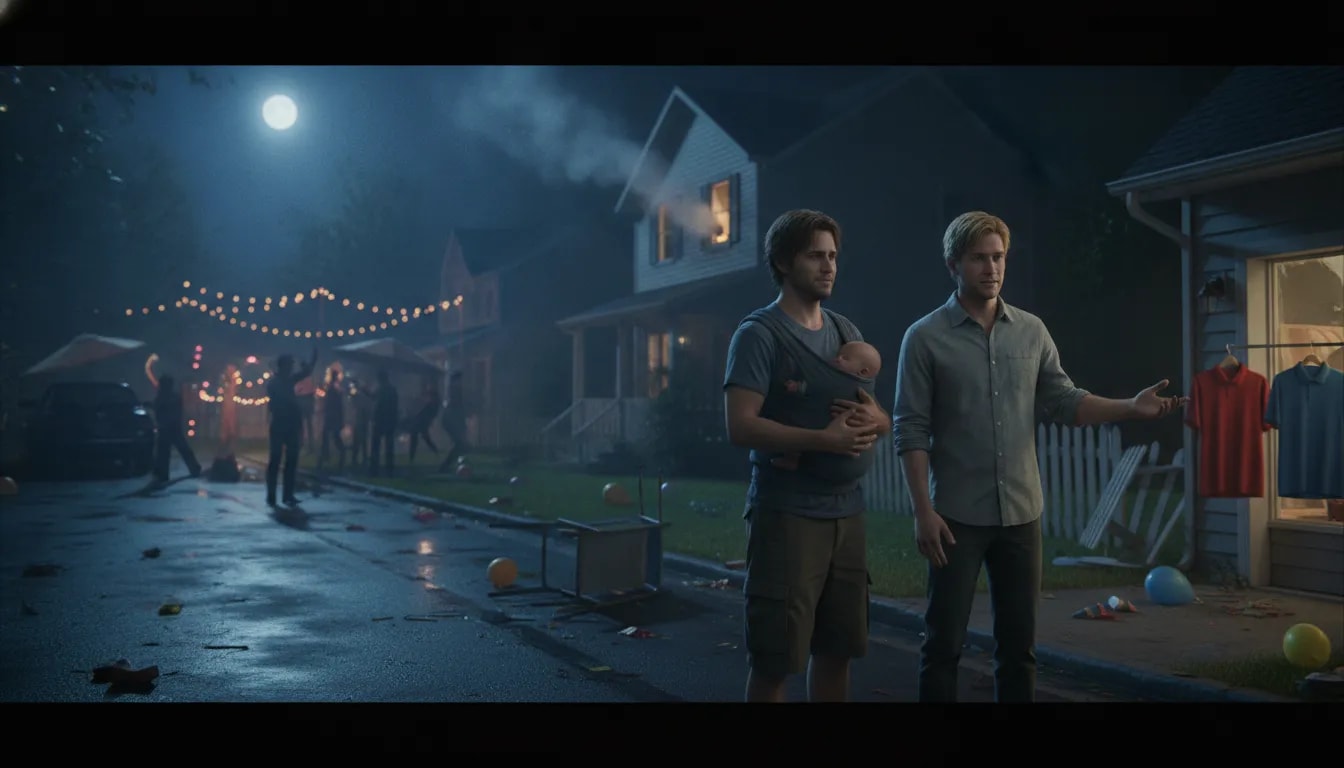
Neighbors ends exactly the way a movie about an escalating suburban war should end: with a giant party, a police raid, a damaged house, an exhausted couple, a baby dressed like Walter White, and two former enemies somehow becoming shirtless retail greeters.
On paper, Mac Radner and Teddy Sanders should never work as friends. Mac is a new dad trying to hold onto the last scraps of his youthful identity. Teddy is a fraternity president whose entire identity has been built around being the guy nobody can ignore. One has a starter home, a wife, and a baby monitor. The other has abs, a loud house full of brothers, and a deeply questionable definition of leadership.
But the final stretch of Neighbors reveals that their feud was never just about noise, parties, or property lines. It was about two guys staring down the same terrifying thing: growing up.
Mac and Kelly learn that becoming parents does not mean their lives are over. Teddy learns that fraternity life cannot be the only thing he is ever good at. And by the time Mac runs into Teddy four months later outside Abercrombie & Fitch, both of them have landed somewhere unexpected, ridiculous, and weirdly sincere.
The Party That Had to End
The Delta Psi Beta party begins as the kind of enormous, green-lit fraternity spectacle that makes reasonable people call the police and makes Teddy feel like he is doing exactly what he was born to do. The house is packed. The music is blasting. Bodies are moving everywhere. There are lights, fireworks, shouting, and the sort of chaotic energy that could only end in medical bills or a criminal charge.

For Teddy, this party is supposed to be the last great declaration of fraternity brotherhood. The brothers are facing consequences for everything that happened during the war with Mac and Kelly, and the house is on the edge of collapse in more ways than one. Teddy has been trying to prove that he is loyal, fearless, and willing to sacrifice everything for Delta Psi Beta.
There is a problem, though. He has taken that belief way too far.
When Jimmy is preparing to leave, Teddy finally drops the tough-guy performance. He admits that he pushed things beyond the limit and insists that Jimmy should not have to take the fall. Underneath all the shouting and frat-house nonsense, Teddy genuinely cares about his brothers. He does not want them to lose their futures because he could not let go of one final party.
That is what makes the scene land. Teddy is still dramatic enough to speak as if he is a dying supernova, but the emotion underneath the speech is real. He has been treating the fraternity as his entire universe, because without it he does not know who he is.
The farewell becomes a flood of increasingly desperate declarations of love. Everybody says it. Then says it again. Then yells it. Eventually, the only useful advice is to get out of the house before the whole thing comes down around them.
It is loud, absurd, and heartfelt at the same time. That is the Neighbors move.
Mac and Kelly Stop Being the People Outside the Party
Mac and Kelly have spent much of the story caught between two identities. They are responsible parents now, but they do not want to become boring people who only talk about baby schedules and mortgage payments. Their war with the fraternity has been partly about defending their home, but it has also been a ridiculous attempt to prove they can still keep up.
At the party, they finally understand that they do not need to defeat youth in order to become adults. They need to accept the version of adulthood they are actually living.
Their moment of victory is not elegant. They are filthy, sweaty, exhausted, and running on pure survival instinct. Yet when they realize they have made it through the chaos, the mood changes. The huge battle has ended. The danger is over. They did it.
Then comes the kind of conversation that makes the movie more than just a collection of very loud pranks.
Mac and Kelly acknowledge that having a child has permanently changed their lives. There is no going back to being completely free of responsibility. There is no magical reset button that brings back the old version of their twenties. Parenthood means somebody will always need them, even when they are old and exhausted and would very much like to sleep until noon.
But instead of treating that realization like a tragedy, they find the comedy in it. They are already becoming people who get excited about brunch, fresh coffee, tomato gardens, storage containers, and fancy hand soap. The horror is not that they have changed. The horror is that they actually like it.
That honesty is the key. Mac and Kelly are not pretending that parenthood is effortless, glamorous, or constantly joyful. They are also not pretending they secretly want to be back at every party. They are learning that it is possible to miss an old life while loving the new one.
Kelly puts it best in spirit: they were afraid of missing the party, only to realize that their family is now the party they most want to attend.
That is a surprisingly tender realization for a movie that opened with a fraternity house glowing like a radioactive nightclub.
Growing Up Does Not Mean Becoming Boring
The ending of Neighbors does not argue that adulthood is superior because it is quieter, more organized, or better at buying storage containers. It argues that adulthood becomes meaningful when you stop seeing responsibility as the enemy of fun.
Mac and Kelly do not become humorless. They make a full calendar of their daughter Stella dressed as pop-culture characters. They still joke too much. They still exaggerate everything. They still find a way to turn late-night parenting fatigue into a conversation about ranch dipping sauce.
What changes is the target of their energy. At the start, they are desperately trying to be accepted by the cool people next door. By the end, they do not need that approval. Their home, their relationship, and their child have become enough.
That does not mean they have given up their edge. It means they have finally stopped confusing chaos with a good time.
The movie’s humor gets a lot of mileage out of this tension. A new parent’s greatest fear is not always a diaper blowout. Sometimes it is realizing that a party has happened without you and, worse, realizing you are relieved you were not there. Mac and Kelly need to grieve a little for their old life before they can enjoy the life they have.
The bizarre comfort of domestic life
There is something deliberately funny about the things Mac and Kelly suddenly love. A tomato garden. Fresh coffee. A trip to The Container Store. Seashell-shaped soap that smells like lemongrass.
None of these things are presented as huge achievements. That is the point. The couple is finding joy in small, embarrassingly grown-up pleasures. Their old idea of a good night might have required a packed room and a story nobody could remember the next morning. Their new idea can involve snacks in bed after their child falls asleep.
It is not less fun. It is just a different kind of fun, with fewer fireworks and more dipping sauce.
The Police Raid Makes the Consequences Real
For all the fraternity’s claims about brotherhood and glory, the final party cannot remain consequence-free. Police cars arrive. Lights flash across the street. The fantasy of one last perfect blowout crashes directly into reality.

This moment matters because it forces Teddy to choose between the image of being a fearless fraternity king and the actual wellbeing of his brothers. Earlier, he was committed to turning every conflict into a test of loyalty. Now he has to recognize that protecting the people around him may mean telling them to leave.
The party ends, but the relationships survive. Teddy and Pete remain connected. Mac and Kelly have made peace with the fact that they are no longer college-adjacent cool people. Everybody carries some damage from the war, but the movie lets them move forward.
It is a fitting conclusion for a rivalry that became absurdly personal. Nobody truly wins because they destroyed the other side. The only real win is escaping the cycle of escalation.
Four Months Later: Teddy Has a New Job
Four months after the final party, Mac runs into Teddy outside an Abercrombie & Fitch store. Teddy is shirtless, standing in front of the entrance, and working the exact kind of job that feels both perfectly suited to him and hilariously beneath the grand destiny he once imagined.
He is still physically imposing. He is still charming. He is still capable of turning a basic interaction into an earnest bro moment. But the fraternity president who saw himself as a once-in-a-generation leader has entered the working world.
And honestly, he is doing fine.

Teddy explains that the other brothers are finding their own paths. Pete is working as an architect. Others are living together off campus. Teddy himself is making a living as a shirtless Abercrombie model, greeting people outside the store and offering a very particular kind of retail enthusiasm.
Mac, meanwhile, admits that he probably should have studied more while he was in college. He is going to night school to finish his degree. It is a small confession, but an important one. Mac has spent so much of the movie defending his status as a functioning adult that he has not always acknowledged his own unfinished business.
Now both men are trying to improve their lives in ways that are decidedly unglamorous. Teddy is working retail. Mac is returning to school. Neither path looks like the fantasy they might have imagined, but both are honest steps forward.
Why the Abercrombie & Fitch Scene Works
The scene is funny because the contrast is immediate. Teddy is effortlessly built for the shirtless-model job. Mac is very much not. The store has hired one guy who looks like the advertisement and one guy who looks like he stopped by because he was emotionally supportive.
Yet Mac does not treat Teddy’s job as a failure. He teases him, of course, because that is the language of their friendship. But he also sees that Teddy is okay. Teddy has a job. He is showing up. He is not trapped inside the old fraternity house, replaying the same last-party fantasy forever.
When Teddy tells Mac that he could do this job too, Mac gives it a shot. He removes his shirt, attempts the same confident posture, and discovers that the two of them look wildly different standing in the same spot.
Teddy’s response is not cruel. He tells Mac to relax and be free. Mac tries. Their attempt to welcome shoppers becomes a strange, awkward double act. Teddy makes the store feel aspirational. Mac makes it feel achievable.
That joke lands because it is also a pretty accurate summary of their entire relationship.
- Teddy represents the intimidating ideal: young, confident, attractive, and apparently built to stand under store lighting without a shirt.
- Mac represents the ordinary version: insecure, funny, trying his best, and much easier to relate to.
- Together they make a more complete picture of adulthood than either could manage alone.
Mac is the relaxed fit. Teddy is the model on the wall. Somehow, that makes them a team.

Mac and Teddy Become Friends Without Losing Their Edge
One of the nicest things about the ending is that it does not force Mac and Teddy into a sentimental, polished friendship. They do not suddenly become best friends who spend every weekend having profound conversations. Their connection remains awkward, competitive, and full of insults.
But it is real.
They survived a ridiculous conflict that brought out the worst in both of them. Mac learned that he could be petty and reckless when his pride was involved. Teddy learned that charisma does not excuse irresponsible leadership. Once the war is over, they can see each other more clearly.
Mac sees Teddy as a person with a future beyond his fraternity. Teddy sees Mac as more than the old guy next door trying to kill the vibe. That change is huge, especially considering how aggressively they once tried to ruin one another’s lives.
Their friendship works because each has something the other needs.
- Mac gives Teddy a picture of adulthood that is imperfect but stable.
- Teddy reminds Mac that growing up does not require losing every impulsive or ridiculous part of himself.
- Both men learn that identity cannot depend on one role forever, whether that role is fraternity president, party guy, young parent, or suburban homeowner.
That is why the Abercrombie scene is more than a tag joke. It shows two people who have moved beyond the identities that started the fight.
Meanwhile, Mac and Kelly Make Stella the Main Event
Back home, Mac and Kelly are putting together their Stella calendar. Their daughter is dressed in a tiny yellow hazmat suit, complete with blue drink mix as pretend meth for a Walter White costume. It is the sort of joke that is equal parts committed, inappropriate, and exactly what this couple would find hilarious.

The calendar sequence matters because it confirms the emotional conclusion Mac and Kelly reached after the party. They are not merely tolerating parenthood. They are making it theirs.
They have turned parenting into a shared bit, a handmade project, and a source of private jokes. The scene is domestic, but it is not dull. There is a tripod, props scattered around the living room, a laptop full of questionable costume ideas, and a tiny human who has no idea she is being cast as one of television’s most morally compromised antiheroes.
When someone suggests they join another party, Mac and Kelly do not hesitate. They have no interest in leaving their calendar project behind. The old fear of missing out is gone. They are comfortable missing the event because they have chosen what they want to be doing instead.
It is an important distinction. They have not been pushed out of youth culture. They have opted into their own life.
The Ending Is About Choosing What Comes Next
Neighbors is built around escalation. Every attempt to solve the conflict makes it bigger. A noise complaint becomes sabotage. Sabotage becomes all-out war. The fraternity’s desire for one final legendary party becomes an actual disaster.
The ending breaks that pattern.
Mac and Kelly stop trying to prove they are still the people they used to be. Teddy stops trying to prove he can keep the fraternity frozen in time. Each character accepts that life has moved forward, even if the next chapter is embarrassing, uncertain, or requires standing shirtless in front of a clothing store.
That is the real punch line. Nobody reaches a perfect adulthood. Mac does not become effortlessly sophisticated. Teddy does not become president of anything. Kelly does not suddenly stop finding chaos entertaining. They simply grow enough to recognize that the next stage does not have to look like the last one.
Growing up in Neighbors is not a noble montage set to inspirational music. It is a police raid, a night-school plan, an awkward retail job, and an extremely elaborate baby calendar. It is ridiculous. It is messy. It is still life.
Where the Ending Leaves Everyone
- Mac and Kelly: They have embraced parenthood without surrendering their sense of humor. Their family life is now the place where they want to be.
- Stella: She is the center of Mac and Kelly’s world and the unwilling star of a pop-culture costume calendar.
- Teddy: He has left the fraternity bubble behind and is beginning a more ordinary, more sustainable kind of future.
- Pete and the other brothers: They are moving into post-college life, with at least one brother pursuing architecture and the group still connected outside the old house.
- Mac and Teddy: They are no longer enemies. They are not exactly normal friends either, which is probably better.
The suburban house is no longer under siege. The fraternity party is over. The police have gone. The people left standing have had to become a little more honest about who they are and what they want.
And somewhere outside Abercrombie & Fitch, two shirtless guys are trying to make retail feel welcoming.
That is not the future anyone planned. It is just the future they got. And it is kind of perfect.
For more film information, see Universal Pictures’ official page for Neighbors and the IMDb listing for the 2014 film.
Frequently Asked Questions About the Neighbors Ending
Why does Teddy work outside Abercrombie & Fitch at the end of Neighbors?
Four months after the final party, Teddy has moved on from fraternity life and is working as a shirtless store greeter and model. The job is a joke about his looks, but it also shows that he is starting a life beyond being fraternity president.
Do Mac and Teddy become friends in Neighbors?
Yes. Their relationship remains awkward and competitive, but the ending makes clear that the feud is over. Mac visits Teddy, congratulates him on moving forward, and eventually joins him outside the store.
What happens to Mac and Kelly at the end of Neighbors?
Mac and Kelly embrace their life as parents. Rather than feeling like they are missing every exciting thing, they realize their family life is the place they want to be. They are also busy creating a costume calendar featuring Stella.
What is Stella dressed as in the ending of Neighbors?
Stella is dressed as Walter White from Breaking Bad, wearing a yellow hazmat suit while Mac and Kelly prepare a themed photo for their calendar.
What does the ending of Neighbors mean?
The ending is about accepting change without losing personality. Mac and Kelly accept parenthood, while Teddy accepts that his future has to extend beyond the fraternity. None of them become completely different people, but they all grow up a little.


