
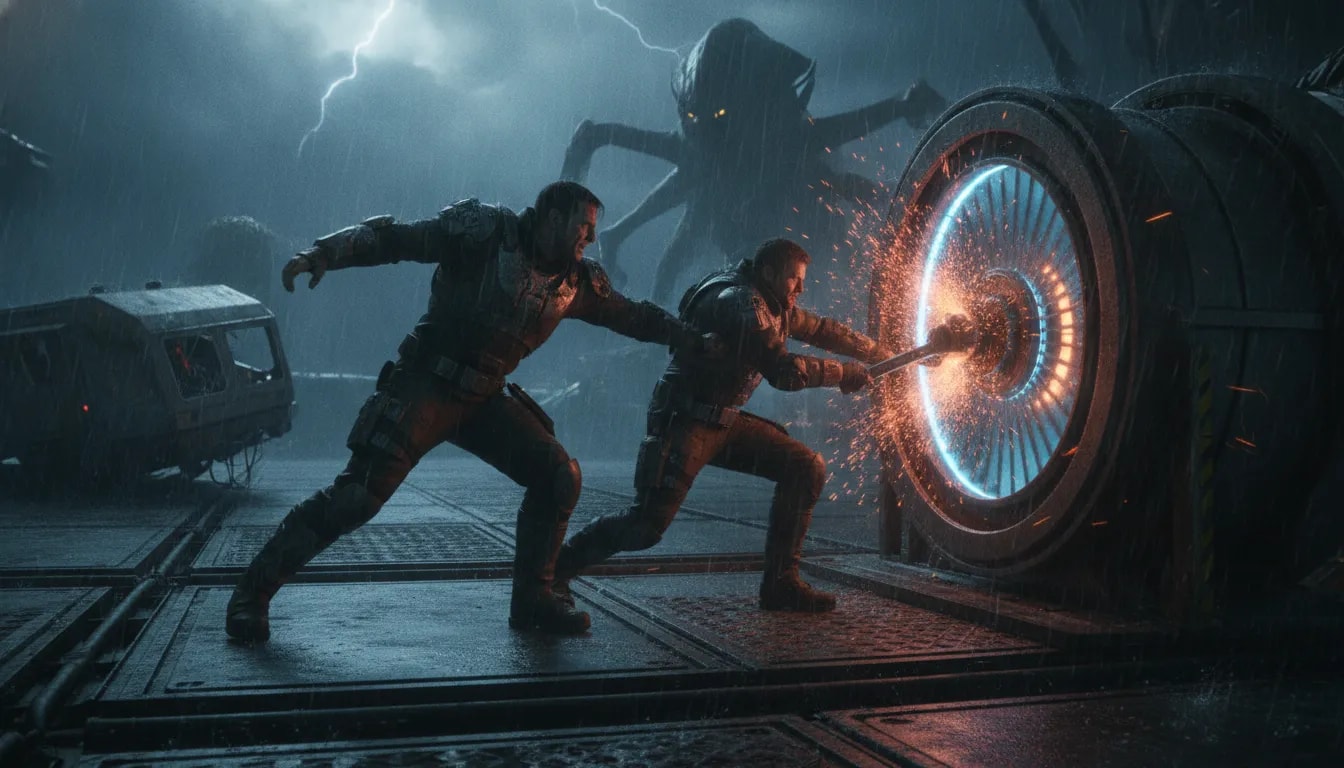
On this planet, nobody gets to pretend for long.
The rain comes down hard. The predators are closing in. The only way out is a transport with limited space, limited time, and exactly one chance to work. That is when Diaz makes his move.
He wants the vehicle. He wants the escape route. More importantly, he wants control over who gets left behind.
Riddick sees the whole play before Diaz can finish selling it.
The turbine pin confrontation is not just a fight over transportation. It is the moment the crew learns why their exit was sabotaged, who has been playing both sides, and what happens when a man mistakes fear for authority. Diaz pulls a turbine pin, cripples the transport, then tries to use the resulting panic to claim the only ride off the planet.
Bad move.
A Planet Built to Strip People Down
Riddick drops its characters onto a brutal world where human plans do not last long. Riddick, the escaped convict and hunted antihero, has already endured a sun-scorched wasteland and the creatures living beneath it. The arrival of bounty hunters changes the equation, but it does not make the planet any safer.
The mercenaries come for a payday. Riddick becomes the target. Then the weather turns, the predators emerge, and the bounty turns into a survival problem.
That setup matters because it removes every comfortable illusion. There is no backup coming. There is no safe place to wait. There is no endless fuel, no spare transport, and no room for a bad decision.
Under pressure, people reveal their real operating system.
Some hold the line. Some make hard choices for the group. Some look for the first chance to save themselves, even if everyone else pays for it.
Riddick understands this better than anyone in the group. He is not sentimental about human nature. He does not need a confession to know when somebody is lying. He looks at the outcome, the opportunity, and the cost of the move. Then he asks the only question that counts: who benefits?
Jones Learns the Truth About His Son
Before the turbine pin gets exposed, the tension is already personal.
Johns is still carrying the weight of what happened to his son, Santana. He wants to believe there is a clean story behind it, one where his son was betrayed or murdered by Riddick without cause. Riddick gives him something worse: a version of the truth that makes Santana responsible for his own choices.
Riddick says Santana had a morphine habit and had become willing to kill a child to protect himself. For Johns, that is almost impossible to accept. The son he remembers is not the man Riddick describes.
But that is the point.
People tend to remember those close to them in the best possible light. They fill in missing facts with loyalty. They protect the image because admitting the truth would mean accepting that they did not know someone as well as they thought.
Riddick does not offer comfort. He offers the sharpest version of what happened. Santana was not a victim of some random cruelty. He was compromised, desperate, and ready to sacrifice somebody weaker to preserve his own life.
The morphine detail is not there merely to explain addiction. It is there to show erosion. Riddick frames it as something that softened Santana’s mind and weakened his resolve. In his world, the problem is not only what a person takes. The problem is what that weakness makes them willing to do when everything starts falling apart.
Johns wants to reject the story because it ruins the version of his son he needs to believe in. Riddick’s response cuts through that denial: if Johns cannot recognize what Santana became, then he never truly knew him.
It is a cold statement. It is also the kind of truth this planet keeps enforcing.
The Difference Between Reputation and Character
Riddick’s description of mercenaries gets right to the nerve. They can look upright. They can talk about rules, duty, payment, and doing the right thing. Cut beneath the surface, though, and sometimes there is nothing holding them upright at all.
That is the distinction between reputation and character.
- Reputation is what somebody looks like when conditions are stable.
- Character is what remains when fear, pain, scarcity, and opportunity arrive together.
- Courage is not sounding tough. It is refusing to make the weakest person pay for your escape.
- Weakness is not being afraid. Everybody is afraid out there. Weakness is using that fear as an excuse to betray the people beside you.
Santana fails that test. Diaz is about to fail it too, only with a lot more muscle behind the failure.
Diaz Wants the Only Ride Off the Planet
Then Jim O’Keefe shows up, and the transport problem comes into focus.
There are two teams, two groups with a claim on escape, and one vehicle capable of getting them out. The situation is already tense before anybody raises a weapon. People who were hunting the same target are now forced to decide who gets the transport, who gets stranded, and whether cooperation is even possible.
Diaz makes it clear he is not interested in riding with Riddick again. He sees a scarce resource and wants it for himself. In a different situation, that might look like a hard but practical bargaining position.
Except Diaz has already rigged the board.
He pulled a turbine pin.
The sabotage is a small physical act with massive consequences. Remove a critical component from the transport and it cannot leave. Disable the only way out, and suddenly everyone must bargain from panic. The person who knows why the vehicle is broken gains an advantage over everyone else.
That is Diaz’s plan. Damage the escape route. Let the confusion spread. Take control of the remaining path out. Leave the rest of the crew with no choices.
It is not leadership. It is hostage-taking with machinery.
Riddick calls it immediately. Diaz intended to take the transport for himself and ghost the others. He was prepared to leave them alone on a planet full of predators while a lethal storm closes in.
The accusation hits because it explains everything at once.
Why is the transport compromised? Why is Diaz so eager to dictate the terms? Why is he acting as though he has already decided who gets to live?
Because he has.
Why the Turbine Pin Changes Everything
A turbine pin sounds like a small thing. That is exactly why it is such an effective detail.
Survival does not always collapse because of some massive explosion or dramatic betrayal. Sometimes it comes down to one missing part, one concealed choice, one person deciding that everybody else is expendable.
Diaz did not merely oppose Riddick. He sabotaged the group’s ability to escape. That takes the conflict beyond rivalry. He created a crisis, then tried to profit from it.
Riddick recognizes the move because he understands predators, and not only the alien kind crawling through the rain. A predator does not need to be loud. It can stand nearby, act useful, wait for the right moment, and strike where the group is weakest.
Diaz’s move follows a recognizable pattern:
- Identify the resource everyone needs.
- Secretly damage access to it.
- Allow fear and confusion to do the work.
- Present yourself as the person who gets to decide the outcome.
- Abandon anyone who cannot fight back.
That strategy only works while the sabotage stays hidden.
Once Riddick names the turbine pin, Diaz loses the advantage. The group no longer sees a man making tough calls. They see the man who manufactured the emergency.
That is a different kind of enemy.
Riddick Does Not Need to Make a Speech
Riddick’s power in this confrontation comes from how little he needs to explain.
He does not spend time trying to persuade Diaz to become better. He does not appeal to a shared code. He does not act surprised that a frightened mercenary would sacrifice others to save himself.
He exposes the truth, then moves.
That is the rhythm of the scene. Diaz talks like he has control. Riddick reveals the turbine pin. The balance changes. Then the planet makes the rest of the argument for them.
Riddick’s earlier exchange with Johns prepared the ground for this. Johns did not want to believe his son lacked the backbone to make the right choice. Diaz is given the same kind of test, and he fails it in real time.
Riddick’s line about seeing whether the lack of spine runs in the family lands as more than an insult. It is a challenge. Santana chose self-preservation over a child’s life. Diaz chooses self-preservation over the entire crew. Different situations, same weakness.
On a world like this, that weakness does not stay theoretical for long.
The Ground Game Begins
With the transport compromised and the predators incoming, Riddick shifts the plan. If the air escape is blocked, they go to the ground game.
The phrase matters because it is Riddick’s territory.
He has survived this planet longer than the mercenaries have. He knows what moves in the dark. He knows that the rain brings the creatures out. He knows that trying to force a clean escape can get everyone killed. When the plan changes, Riddick is no longer reacting to a problem. He is fighting on terrain he understands.
Diaz may be physically imposing, armed, and used to controlling a crew. None of that means much when the environment turns against him. The rain is relentless. Visibility is poor. The creatures are fast, numerous, and built for the conditions.
The group has to move, shoot, reload, and stay alive while the ground itself becomes a battlefield.
There is no time left for status games.
The confrontation turns into action because survival on this planet never pauses for human conflict. The predators do not care who owns the transport. They do not care who had the bigger claim, who was betrayed first, or who thinks they deserve another chance. They come for anything vulnerable enough to be caught.
That is why Diaz’s sabotage is so reckless. He does not just make the group angry. He burns time they cannot afford to lose.
Competence Is Not the Same as Size
The action around the ground game reinforces one of the central ideas in Riddick: raw strength is useful, but awareness wins.
Diaz is not helpless. Neither are the other mercenaries. They have weapons, training, armor, and experience. But Riddick has something more valuable in this specific fight. He knows the system they are trapped inside.
He knows the terrain. He reads danger early. He spots the hidden move. He adjusts instead of clinging to a plan that has already failed.
That is competence under pressure.
It is not about looking fearless. Riddick does not pretend the situation is safe. He simply sees the situation clearly enough to act. The other people around him are often busy arguing with reality, denying it, or trying to bend it to their own advantage.
Reality wins every time.
The Repair Becomes the Real Priority
After the immediate chaos, the focus returns to the transport and the missing component.
The group needs to know whether the machine can still work. There is no room for ceremony. Somebody has to fit the part, test the system, and find out whether the route off the planet is still alive.
Riddick’s instruction is blunt: put it in and see if it is still good.
That is the practical heart of the sequence.
Once the turbine pin is identified, blame alone does not solve anything. The crew cannot survive on the satisfaction of being right about Diaz. They need the transport operational. They need an answer. They need to leave.
This is another reason Riddick stands apart from the mercenaries. He does not confuse exposing the betrayal with completing the job. Calling out the sabotage is step one. Getting the only viable exit working is step two.
The sequence moves through three clear survival stages:
- Identify the deception. Riddick recognizes that Diaz caused the transport failure.
- Survive the immediate consequence. The group shifts into a ground fight as the predators close in.
- Restore the escape route. The turbine pin must be put back and the transport tested.
That progression is clean because it has to be. Every extra minute on the ground raises the cost. Every argument leaves somebody exposed. Every selfish move risks turning a desperate group into easy prey.
There Is No Easy Redemption in a Crisis
The turbine pin confrontation is harsh because nobody gets much time to explain themselves.
Johns has to face the possibility that his son was not who he believed he was. Diaz has his sabotage exposed when the group can least afford it. Riddick remains what he has always been: dangerous, observant, and unwilling to let a lie stand just because the truth hurts.
The movie does not ask anyone to be perfect. It asks what they do when survival gets ugly.
Santana had a choice. Diaz had a choice. Johns has a choice about whether to keep clinging to a false story. The crew has a choice about whether to keep fighting each other or repair the only thing that can carry them out.
Riddick’s worldview is severe, but it is consistent. A person’s words mean very little when the pressure rises. What matters is the line they will not cross.
Diaz crosses it when he sabotages the transport.
Riddick draws his line when he refuses to let that betrayal go unanswered.
What Makes This Riddick Scene Hit So Hard
The confrontation works because it compresses the whole story into one brutal problem.
- The environment is hostile. The storm and predators turn every delay into a life-or-death risk.
- The resource is limited. There is one transport and no comfortable backup plan.
- The betrayal is practical. A pulled turbine pin is not symbolic sabotage. It threatens the group’s survival directly.
- The emotional stakes are already loaded. Johns is still wrestling with what happened to Santana and what that says about his family.
- Riddick sees what others miss. He identifies the real threat before Diaz can fully capitalize on it.
- The consequences arrive fast. Once the ground game begins, nobody has the luxury of avoiding the truth.
That is the engine of the scene. Nobody is safe enough to lie comfortably.
Diaz thinks he can control the exit by breaking it. Riddick shows him the flaw in that plan. If you sabotage the only ride off a monster-infested planet, you are not the man in control. You are just another problem standing between everyone else and survival.
Riddick’s Lesson: Fear Does Not Excuse Betrayal
Fear is everywhere in this confrontation. Johns fears the truth about his son. Diaz fears being trapped with Riddick and the creatures. The crew fears the storm, the darkness, and being stranded. Those fears are real.
But fear does not get to write the rules.
Riddick is not presented as clean, gentle, or easy to trust. He is an antihero for a reason. Yet in the turbine pin confrontation, he is the one insisting on the truth of the situation. He is the one who sees that a man has endangered everyone to secure his own escape. And he is the one who pushes the group back toward the only goal that matters: get the transport working and get off the planet.
That is why the scene sticks.
It is not just a showdown between Riddick and Diaz. It is a test of what people become when there is only one way out. Diaz tries to make the crisis serve him. Riddick forces the crisis into the open.
One pulls the pin.
The other calls it out cold.
For more context on the film’s cast and production, see IMDb’s Riddick listing and the official Universal Pictures Home Entertainment page for Riddick.
Frequently Asked Questions
What did Diaz do to the transport in Riddick?
Diaz pulled a turbine pin, sabotaging the transport the group needed to escape the planet. Riddick exposes the sabotage and explains that Diaz intended to take the only ride for himself while leaving the others stranded.
Why does Riddick confront Johns about Santana?
Riddick tells Johns that Santana had become dependent on morphine and was prepared to kill a child to protect himself. Johns struggles to accept that his son could have made such a choice, but Riddick refuses to soften the truth.
What does Riddick mean by switching to the ground game?
With the transport disabled and predators attacking, Riddick shifts the group from arguing over escape to surviving the immediate fight on the ground. It is a change in tactics forced by Diaz’s sabotage and the planet’s escalating danger.
Why is the turbine pin confrontation important?
The scene reveals Diaz as the source of the transport failure, connects his betrayal to the earlier discussion of Santana’s cowardice, and forces the group to repair their only path off the planet while fighting for survival.


