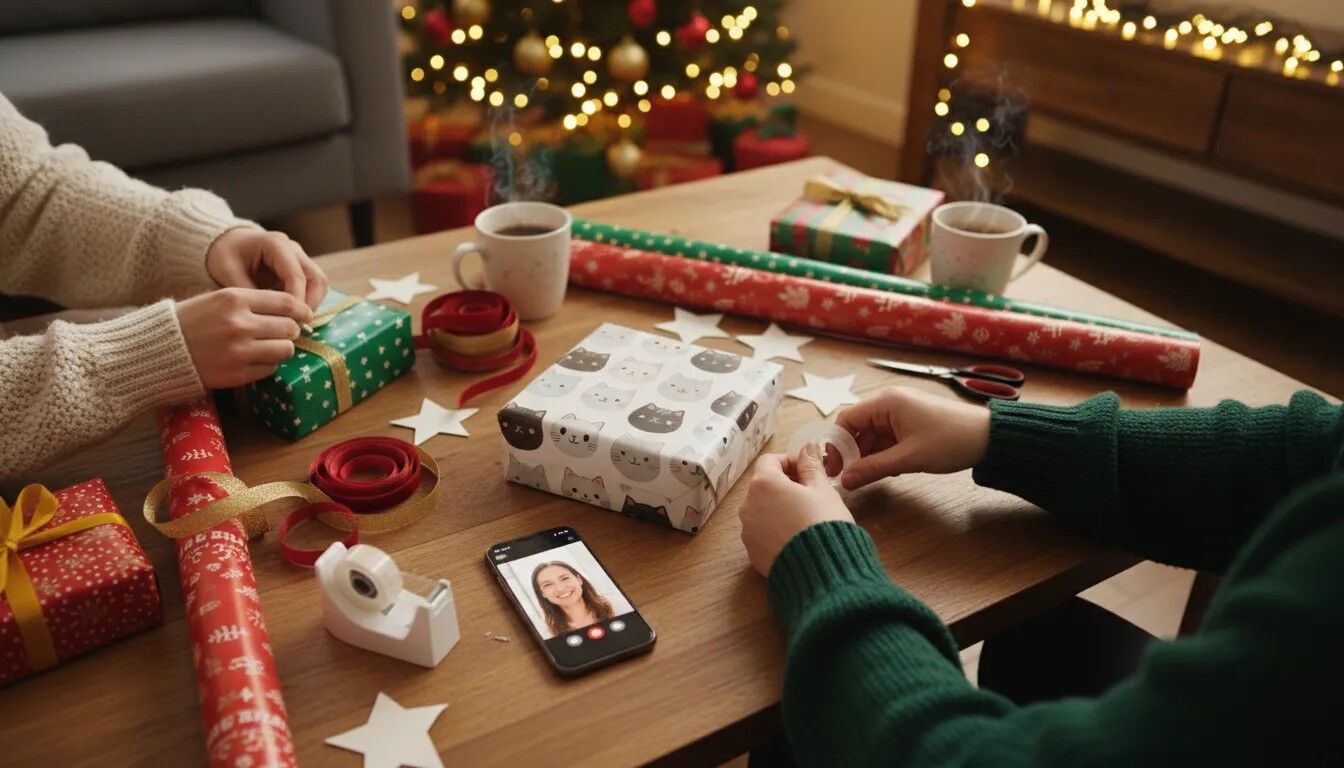
We thought we would make a night of the last-minute Christmas chaos and turn wrapping into something cozy and companionable, like being on FaceTime with a friend. What started as a small to-do—wrap one last Secret Santa for our housemate—quickly turned into a full-on festive production: tape disasters, custom wrapping paper starring our cat Boots, frantic searches for scissors, and the existential panic of missing parcels. We learned a lot along the way about practical wrapping hacks, how to make small gifts feel deliberate, and how to keep the spirit of gifting alive even when the calendar is stacked.
The Opening Act: Tape, Tools, and Tiny Disasters
Every gift-wrap session has a moment when we realize things are not going to be straightforward. For us that moment came with a tape dispenser. It refused to cooperate, then physically fell apart. The metal blade came loose, the tape got stuck to itself, and we spent a good five minutes treating a tape dispenser like a puzzle we had no right to solve. The result? We improvised. We took a breath. We learned a small, practical lesson: don’t let a tiny tool derail the whole evening.
Here are a few quick tool-centric rules we now try to follow:
- Test your tape beforehand. If the dispenser is giving you grief, set it aside and use double-sided tape, washi tape, or a small roll of cello tape you can tear with scissors.
- Keep scissors in a consistent place. Nothing kills momentum more than hunting for scissors. Put a designated pair in your wrapping box and leave them there year-round.
- Have spare adhesives. A small stash of double-sided tape and a couple of washi rolls are lifesavers for different textures and fragile surfaces.
Why Wrapping Matters More Than We Admit
Wrapping is the first sensory experience of a gift. It sets the tone. It can say “thoughtful” or “rushed,” “homemade” or “boutique.” We buy things with care, but wrapping is where those intentions get communicated before the bow is untied.
This year we decided to lean hard into the theatrics and ordered custom wrapping paper. Not for everyone, just for Jordan’s Secret Santa. That choice was half nostalgia, half revenge—last year Jordan teased our wrapping choices by saying, “Mine are the ones in the really cute wrapping and Jack’s are the other ones.” We took that as a design challenge. The result: Boots, our resident cat and unofficial book club mascot, staring back at us from a metre-wide sheet of paper. Personal, slightly ridiculous, and absolutely delightful.
Choosing Custom Wrapping Paper: When It’s Worth It
Custom wrapping paper can feel extravagant, but it has specific moments when it’s a perfect choice:
- For people you want to celebrate with a wink. A pet, an inside joke, or a memorable photo on the wrap makes the unwrapping a two-step gift: the paper and what’s inside.
- For a one-off special occasion. Secret Santa can be small, but a bespoke wrap can make a modest present feel lavish.
- When production is simple. We used a service that handled printing and shipping, and the sheet arrived in two days. Quick turnaround makes custom wrapping feasible for a last-minute flourish.

If you decide to go custom, keep these considerations in mind:
- Image quality matters. Use a high-resolution photo so it prints cleanly on the sheet.
- Test the pattern. If you want the design to repeat seamlessly, ask for a proof or mock-up so you can see the flow across the paper.
- Think about weight and finish. Some custom sheets feel like heavy poster stock. That can be beautiful, but it behaves differently when you fold it around boxes or soft shapes.
Secret Santa Essentials: Planning, Budget, and the Housemate Factor
Secret Santa isn’t just a list and a budget—it’s an opportunity to flex empathy and creativity. When the giftee is a housemate, it gets even more interesting. We live together, share a lot, and have overlapping tastes, so we had to ask ourselves: are we buying for the person or for the person-as-roommate?
Two dynamics made our planning practical:
- Jordan is easy to buy for because she has many enthusiasms. She tells us what she’s into, and her curiosity makes shopping straightforward.
- Jordan also buys things for herself impulsively. That means we either need to be faster or more imaginative to avoid gifting something she already owns.
To cope with the impulse-control conundrum, we made a running note of gift ideas throughout the year. Some items are practical, some are indulgent, and some are purely personal. This helped us avoid huge over-budget splurges while still making the reveal special.
What We Wrapped and Why: Gifts with Thought Behind Them
We assembled a small suite of presents that felt personal, practical, and slightly playful. The mix had three aims: utility for the home, nods to personal interests, and narrative gifts that invite exploration.
Oven Mitts that Match the Living Room
Practicality disguised as decor. We bought a set of oven mitts whose color palette ties into the living room—warm oranges and deep reds—so the kitchen felt intentional as part of the open-plan space. We kept using nice tea towels to grab oven trays, and that was not ideal. A matching set of mitts both protects hands and completes the aesthetic. Full disclosure: this is a tiny selfish present because we share the kitchen.
A Miffy Ornament for the Tree
Miffy is ubiquitous in the house. We have Miffy tees, Miffy cushions, and Miffy casual sightings in corners of bedrooms. The ornament was a simple, affectionate gift: a small, visible token that says we notice the things they love. It’s the kind of present that slots into an existing language of inside jokes and collection habits.
A Silly T-Shirt as an Inside Joke
One gift that landed with a laugh was a tee reading, “I got my appendix removed at Claire’s.” It nods to a stressful real event—an appendix operation—and reframes it as a ridiculous, gallows-humour sort of souvenir. We wanted a present that could make Jordan laugh and diffuse the trauma with a little levity. That’s the power of inside-joke merch: it turns a memory into communal laughter rather than private anxiety.
Books for the DJ-in-Training

Books are our go-to because they are project-oriented gifts. This year our housemate has a DJing itch, so we chose titles that map a path through that interest:
- Rave by Rainald Goetz. A fiction dive into 1990s techno culture, offering a feel for the emotional and sensory universe of raves.
- Last Night a DJ Saved My Life by Bill Brewster and Frank Broughton. A history of the DJ and dance-floor culture across genres. This is the “know your roots” kind of book DJs often call essential.
- Jodie Harsh’s memoir as a companion. If you’re gifting cultural immersion, combine historical context with first-person, contemporary anecdotes.
Choosing books for hobbies is underrated because the right trio can become a mini-curriculum: aesthetics, history, and lived experience.
Wrapping Techniques for Different Shapes
The physics of wrapping change depending on the object. Boxes are forgiving; fabric and awkward shapes require improvisation. We learned three useful approaches:
Boxes: Precision and Pattern Matching
For rectangular parcels, aim for crisp folds and clean edges. When using patterned paper, take an extra moment to align the pattern so the seam sits somewhere neat. If you have a repeating motif like Boots the cat, try to make the repeat intentional rather than off-kilter. Even slight misalignment can look slightly deranged, so we either embrace that chaos or reschedule the wrap.
Soft Items and Fabric: Envelope or Cracker Method
For t-shirts and soft goods, consider two options:
- Envelope fold: Lay the item flat, fold neatly into a rectangular packet, place on matching card for structure, and then wrap as a box.
- Cracker or tube: For light, small items, roll them into tissue and plug both ends. This works best for novelty items but is less suitable with thick, poster-like wrapping stock.
Small Gifts: Embrace Minimalism
Ornaments, fridge magnets, and small trinkets deserve their own tiny presentation. Use the offcuts of custom paper to make a small card or tag. If the magnet hasn’t arrived yet, prepare a placeholder so the recipient still has a tactile moment when they open their other presents.
Paper Choices and How They Behave
Not all paper is created equal. Our custom sheet printed on something close to poster stock, which felt thick and crinkly. That density can be great for bold looks, but it’s harder to stretch, fold, and tape. Here’s how to adapt:
- For thick paper: Use more generous cutting margins to allow for overlap. Score the fold lines lightly with the back of a blunt knife to achieve sharper corners.
- For thin paper: Add a layer of tissue or kraft paper underneath for structure, especially around corners.
- For patterned paper: Try to hide the seam where the two edges meet by aligning pattern elements or placing a decorative sticker over the seam.
Last-Minute Shipping and The Parcel Panic
We had a couple of missing items: a fridge magnet and a mug. The magnet was being customized and potentially contained a location detail that wasn’t appropriate for filming, so its delay was not the end of the world. The mug, however, was a missing aesthetic piece that would have completed the set.

When you’re relying on shipping close to the holiday, consider these strategies:
- Order from multiple suppliers with staggered delivery estimates. If one item is critical, consider a local seller for a quicker turnaround.
- Keep a backup small gift on hand. A candle, a nicely wrapped chocolate bar, or a small plant can fill the emotional space of a missing mug.
- Communicate expectations with the giftee if timing becomes impossible. Honesty beats an empty spot under the tree.
Gifting While Freelancing: Calendar Juggle and Holiday Work
For those of us who freelance, the holiday season can look very different. While many collaborators are taking time off, the audience is often more active. That means more content to make and fewer hands to help. We had to reconcile the creative calendar—editing, photos, proofreads—with the domestic demands of moving, decorating, and wrapping.
The practical tactics that helped:
- Batch tasks. Do all similar jobs at once—wrap packages within a single afternoon, film short sequences in one go, and record voiceovers in blocks.
- Plan for collaborator downtime. Build buffer days into the schedule so edits can be done after people return from holidays.
- Take small rests. Even a brief pause to make tea or play a thirty-second playlist can reset focus and save mistakes.
Small Rituals That Make the Process Feel Like a Holiday
Wrapping is mechanical, but it becomes meaningful with ritual. We put on low-key music—sometimes melancholic holiday songs—and treated the room as a shared space rather than a production line. Turning the process into a mini-celebration keeps the mood light and gives us permission to laugh at tape disasters.
A few rituals we recommend:
- Mix a playlist that matches your mood. You might prefer cathartic ballads at the tree, or something surprisingly solemn that feels tender among the glitter.
- Keep a hot drink station. A simple kettle, a mug, and biscuits make breaks intentional.
- Take photos of the finished stack. They become a satisfying documentation of effort and look lovely in end-of-year recaps.
Gifts That Tell a Story: How to Build Narrative-Driven Presents
The most memorable gifts do one of three things: they fill a practical gap, they honor a passionate hobby, or they tell a story. We aimed for all three.
Think of a gift as a short narrative you can build with a few carefully chosen objects. For example:
- Give a pair of oven mitts, a small recipe card, and a jar of spice. Together they create a “night in the kitchen” story.
- Gift books about DJ culture, a small set of headphones, and a personal mixtape link. Now you’ve created a “beginner’s kit” for a new hobby.
- Combine a personalized magnet, a tiny ornament, and a card that references an inside joke to create a “home is where our stories are” package.
Finishing Touches: Tags, Ribbons, and Presentation
Small details count. We cut off a sliver of the custom paper to make a tag and considered leaving a square of the paper itself as a keepsake. Here are our wrap-finishing rules:
- Tags should be personal. Even a scratchy handwritten line beats a generic printed sticker.
- Match ribbon weight to paper weight. Heavy paper needs robust twine or grosgrain; light paper suits narrow satin or thin jute.
- Keep a little scrap as a memento. For custom prints, a small square of the paper can act as a postcard and memory.
How to Recover from Mistakes

We made several errors—crooked cuts, mismatched patterns, and a broken tape dispenser. Here’s how we fixed things without losing mood:
- Embrace the imperfection. Often the recipient won’t notice a slightly uneven fold. If they do, the story becomes part of the present.
- Correct with style. Use a decorative sticker, a ribbon, or a mini bow to cover small flaws.
- Take a breath and reassess. Walk away for two minutes and return with fresh hands. The mistakes feel smaller when we’re not operating under importunate urgency.
What We Would Do Differently Next Time
We learned some actionable things we’ll apply next year:
- Prepare a wrapping kit early. Tape, spare scissors, a cutting mat, tags, and tape in a single box.
- Order custom prints with more time. Even if the vendor is quick, add a buffer for items that might be thicker than expected.
- Keep a portable gift on hand. A well-wrapped candle or local treat is a perfect backup if a parcel doesn’t arrive.
Festival Talk, Life Plans, and the Sentimental Stuff
While wrapping, we wandered into conversations about life: band lineups, festival plans, and artists who shape us. One particularly resonant moment was talking about how an artist’s albums can feel like maps of our lives. For many of us, music is a defining context—each record meeting us at a certain emotional checkpoint.
If you’re in the market for a life-changing festival experience, try to find events where the curation feels personal and the crowd is open. Smaller, carefully programmed festivals often give the same kind of communal euphoria that bigger ones do, minus the exhaustion.
Final Stack and the Calm After the Crinkle
When the last ribbon was tied and the final tag nailed, we stood back and looked at the stack: a curious, slightly garish collection held together by intention. Boots on paper, books lined up, a t-shirt with a ridiculous slogan, and a Miffy ornament that somehow made the whole pile feel tender.
The lesson was simple: we don’t need perfection. We need presence. Wrapping is an act of care, even when hands shake or tape breaks. The time spent making each parcel look like a small ritual is the real present.
FAQ
What are the essential items to include in a wrapping kit?
A small, reliable wrapping kit should include a pair of sharp scissors, a roll of cello or double-sided tape, a roll of washi tape for decorative purposes, a selection of tags, ribbon or twine, and a few spare sheets of tissue or kraft paper for extra structure. Keep this kit in one box so you always know where it is.
How can we make custom wrapping paper without spending too much?
Use online services that let you print single sheets or small runs rather than bulk. Choose a simple, high-resolution image and opt for digital print on slightly lighter stock to reduce cost. Another approach is to print smaller squares as tags instead of full sheets—this gives the personalized touch without the price tag.
How do we wrap oddly shaped gifts like mugs or ornaments?
For mugs and ornaments, use cushioned tissue or bubble wrap inside a small box to protect the item, then wrap the box. If you want to avoid a box, roll the item in tissue, place it in a small fabric pouch or festive sock, and tie the ends. This gives a quaint, handmade feel while keeping the object safe.
What if a parcel doesn’t arrive in time for gifting?
Keep a backup small gift that can fill the space—a candle, local food item, or a handwritten voucher promising the missing item when it arrives. Be transparent if the giftee asks; most people appreciate honesty and the effort to make a complementary present.
How do we avoid wasting paper with large patterns or thick sheets?
Plan your cuts by laying out all gifts first to minimize waste. Use offcuts creatively for tags and cards. When working with thicker sheets, choose simpler folds and avoid overly complex cracker or tube shapes that the paper can’t handle.
What makes a good Secret Santa gift for a housemate?
Think about shared spaces and personal passions. Practical items for the home (like oven mitts or a plant), hobby-based gifts (books, starter kits), and small sentimental items (custom magnets, ornaments) all work well. A blend of utility and personality tends to land best.
How can we keep wrapping stress-free if we’re working through the holidays?
Batch the task, set a short block of time, and treat it as a ritual. Build deadlines into your calendar that account for collaborators taking time off, and keep tiny, ready-to-wrap backups in the cupboard to reduce last-minute panic.
Closing Thoughts
Wrapping is less about making everything flawless and more about creating a small, shared moment of intention. Whether the tape dispenser falls apart, the paper is thicker than expected, or the mug doesn’t arrive, the real gift is the thought behind each parcel. If we approach it with humor and a little planning, even the chaotic sessions become memories we’ll laugh about next year.
So gather your tools, put on something slightly melancholy or painfully festive depending on your mood, and turn the wrapping table into a place of small ceremonies. Keep a spare roll of tape, a few emergency gifts, and perhaps a picture of a cat to remind you why you’re doing it in the first place.