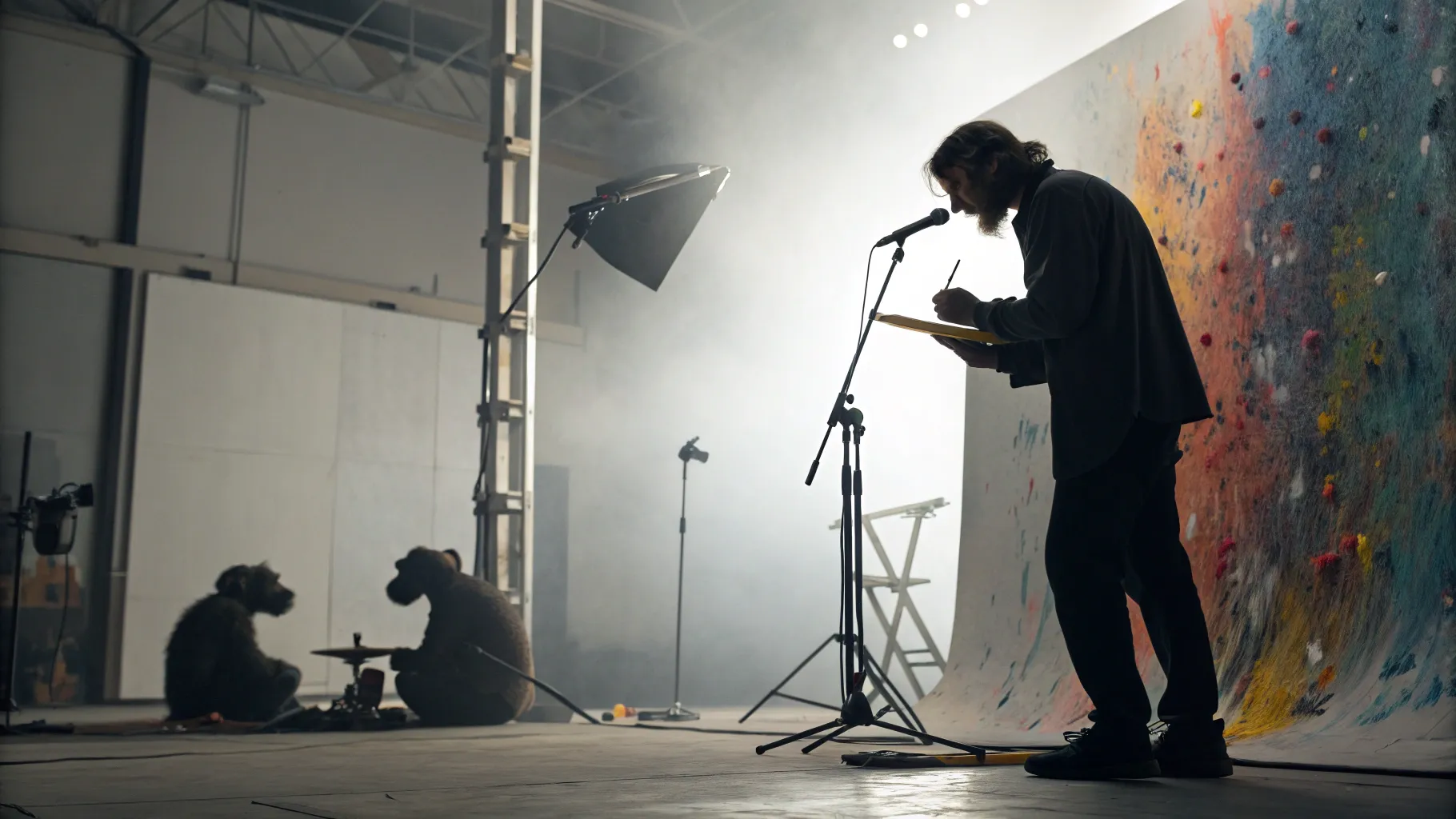
I have a simple rule I live by: create first, analyze later. It sounds obvious until you try it. Beginning artists habitually let a running commentary — the monkey mind — narrate, judge, and stop the work before it has a chance to breathe. That commentary disguises itself as truth, but it is a survival mechanism, not an artistic advisor.
Own your creative identity — rock star energy is a leadership skill
When I say I want to be a rock star, I mean I want to show up with intensity, presence, and authority for my work. That fire is not a literal fantasy for most of us, but an operating system for how we take risks and lead creative projects.
Being the front person in a band is a literal exercise in owning your presence: you put a voice forward, you let others amplify and complete that voice, and you hold responsibility for the direction. That is the same stance you take when you launch a project, pitch a film, or present a gallery body of work. It’s leadership energy applied to art.
Why so many artists try to analyze while creating
We are trained to evaluate. In school, at work, and online we were taught to critique and optimize. But creation and analysis are different states of attention. When we try to evaluate while making, we shut down the generative channel. The critic and the creator cannot effectively share the same neural stage simultaneously.
“Judging your early artistic efforts is artist abuse.” — a truth worth remembering.
That line from Julia Cameron is brutal and liberating. If you measure first drafts against finished works or other artists’ best, you kill momentum and curiosity. Beginner work is not a failure; it is your map. Each imperfect piece shows what you can improve, where you need collaborators, and what to repeat.
Coaching is not therapy. Coaching gets you moving
People often confuse coaching with therapy. They both hold value, but they serve different ends. Therapy explores why; coaching helps you do what. Insight is beautiful. Action is the currency of the creative life. You can collect insights for years and remain stalled. Coaching focuses on what you will do next and how you will create a repeatable practice.
When to work with a coach
- If your vision is clear but the path is foggy: a coach helps convert longing into step-by-step actions.
- If parts of you are at war: coaching blends those parts so your whole self moves forward.
- If you want accountability without being told what to do: a coach partners with you rather than gives orders.

A coach is your creative partner, not your boss. Think of yourself as the CEO of your artistic life. A coach is the team member who keeps the runway clear and helps you select the next authentic action that produces momentum.
What keeps artists stuck — the monkey mind and negativity bias
Our brains evolved to keep us alive. That means scanning for risk and rewarding caution. This negativity bias shows up as the monkey mind — that inner voice swinging from worry to doubt to worry. When you sense risk between where you are and where you want to go, your brain does overtime to block the leap.
The myth is self-sabotage: you are not maliciously ruining your life. Your brain is doing its job. The skill is to observe the chatter, evaluate whether the warnings are true, and choose the action that aligns with your values despite the noise.
A four-step habit to tame the monkey mind
- Observe: name the thought without shaming it.
- Dismantle: test whether the story is fact or meaning attached to a fragment of evidence.
- Integrate: bring the part of you that is fearful into your plan so it can feel seen.
- Act: take a small, authentic next step that proves you can move forward.
Small steps build muscle — how I coach artists to move forward
Big visions terrify the brain. The trick is to walk a stone path through a foggy lake. You cannot see the destination, only the next stone. Take that stone. As you step, the fog clears enough to reveal the next stone. Progress becomes a sequence of digestible actions.
I never ask a client to leap into impossible change. Instead we design the “authentic next action” — the smallest meaningful step that moves the project forward while staying within the client’s energy and bandwidth.
Examples of authentic next actions
- Email 12 friends about a local performance rather than spending weeks strategizing a marketing plan.
- Create a two-page pitch for a film idea rather than planning an entire festival run.
- Book a 90-minute gallery studio day to produce three new pieces instead of waiting for inspiration.
How coaching sessions are structured
A simple framework keeps the work focused and effective. Start by centering the conversation, then identify a single coaching topic the client brings. We work that topic until the client leaves with clarity and a concrete next step.
Typical formats I use:
- Biweekly model: 1-hour Zoom session every other week with a 30-minute phone check in between. That keeps momentum without burnout.
- Monthly deep dive: One 2-hour strategy session per month for 3 to 6 months with supporting check-ins. Think of this as a virtual retreat that resets the month.
There is no single right cadence. The key is consistency and practice. The coach-client relationship is an ongoing place to notice patterns, test assumptions, and keep your creative momentum in motion.
Common mental habits that derail artists

There are recurring thought patterns I call monkey mind symptoms. They are familiar and sneaky because they sound reasonable:
- Comparison: measuring your beginning against someone else’s middle.
- Rationalization: using logistics to avoid the next step.
- Scarcity: believing there are not enough gigs, clients, or attention to go around.
- Black-or-white thinking: either this or that, which forces false choices.
Naming these patterns is the first move toward managing them. Once you recognize a symptom in real time, you can choose to treat it as data rather than destiny.
When you have both a day job and an art dream
One of the most common questions I get: should I take the promotion or stick with art? The answer rarely involves an either-or. Life is messy and cyclical. A promotion that gives you financial breathing room and predictable hours can be an excellent platform to expand your art practice.
You can structure your days, negotiate terms, and protect creative time. Alternatively, you can prototype your art path while keeping the safety net. Prioritize based on values, not guilt.
Multi-hyphenates: how to make many ambitions compatible
You can be a writer, illustrator, screenwriter, and musician. The problem is not multiplicity; it is lack of prioritization and structure. We begin by clarifying the vision: what do you want to be doing this year? Then we pick one idea to move forward with and design a plan for integration so the other interests have a place without everyone feeling abandoned.
- Pick one tangible project as the headliner for now.
- Create container time blocks so different talents get attention in sustainable cycles.
- Use each project’s practice to build transferable skills across disciplines.
Structure is not the enemy — build your map, your way
Artists are often told structure kills creativity. The reality is that structure is the scaffolding that supports creative risk. But structure does not have to copy a corporate calendar. Build a structure that respects your attention rhythm, energy peaks, and creative temperament.
If you have ADHD, neurodivergence, or a non-linear attention style, design systems that reduce friction: hire a web designer instead of wrestling with Squarespace for weeks, schedule computer tasks in short bursts, and protect long stretches for deep creative focus.
Creative blocks are not failures — they are signals
A creative block is not a disease. It is part of the process. Before trying to overcome it, ask a different question: are you blocked or is your system asking for rest? Sometimes what feels like a block is the body telling you to refill.
- Take an artist date: a solo outing chosen to replenish curiosity and play.
- Change your inputs: visit a thrift shop, a bookstore, or a garden.
- Return with constraints: short time, small goals, and permission to fail out loud.

Play is not frivolous. The artists who sustain long careers are often those who guard access to fun and curiosity. Plan regular play appointments with yourself and protect them like a rehearsal schedule.
Fear, boredom, and the culture of comfort
We live in a culture of instant gratification. Boredom is unfamiliar and uncomfortable. That discomfort can show up as avoidance disguised as “bad idea” or “I’m not interested anymore.” Practice sitting with small discomforts without letting them dictate your decisions. Boredom is where creation often brews; if you move immediately to distraction, you never get to the creative growth on the other side.
Money, value, and the artist’s marketplace
Conversations about money are hard because art is personal. There are two parallel creative processes: one for your inner work and one for the market-facing work. Ask yourself: who am I creating for? If you want to monetize, you must design for an audience. If you create purely for personal expression, accept that the marketplace may respond differently.
To increase monetary value:
- Define the lifestyle you want to support and reverse-engineer the revenue you need.
- Understand your audience and the problem your work solves for them.
- Learn basic financial literacy or hire a planner so you can make strategic choices rather than hope for discovery.
Choosing a business model is as creative as choosing aesthetic decisions. Chance the Rapper chose independence; other artists choose label infrastructure. Both are valid. The important thing is that the choice aligns with your creative priorities and financial reality.
Grandiosity versus grounded belief
Artists need to feel big on stage. Grandiosity has a role in performance and marketing, but it is a poor adviser when you are in the research, planning, and budget phase. Separate the two:
- Grandiosity: useful in presentation and risk-taking.
- Grounded belief: required for research, honesty, and iterative improvement.
If a project is wildly ambitious, test its assumptions early. Prototype, measure, and iterate before committing massive resources. Belief without evidence is optimism; belief with repeated testing becomes credibility.
Burnout is a signal, not a moral failure
When the tank is empty, everything becomes labor. Burnout is the body’s way of demanding rest. The world’s hunger for output makes rest feel dangerous, but the sustainable artist understands recovery is part of the practice. Replace guilt with logistics: schedule replenishment intentionally, reduce external obligations during a recovery phase, and use that time to repair the systems that led to the drain.
Common forms of self-sabotage and how to catch them

Self-sabotage rarely looks like dramatic misbehavior. It usually looks like small, pattern-based decisions:
- Believing negative stories and treating them as identity.
- Living in trauma without integration and using suffering as a muse for its own sake.
- Procrastination masked as overplanning or perfectionism.
Interrogate those stories. Ask: is this thought true? What evidence supports it? What is a counterexample? Replace long, judgmental inner monologues with short, curious prompts.
How to maintain creativity for decades
The career you imagine at 25 is not the career you will live at 45. Long-term creativity is less about a single breakthrough and more about a way of life:
- Preserve play and curiosity. Book artist dates and protect them.
- Structure time so creativity can coexist with other responsibilities.
- Create rituals that bring you into a generative mindset quickly.
- Keep a practice of small, consistent output. Frequency beats intensity over time.
The healthiest creatives are those who refuse to let identity be hostage to a single project outcome. They are resilient, curious, and capable of reinvention.
Practical takeaway: a one-week reset for blocked artists
- Day 1: Do a truth inventory — list the fears and the facts.
- Day 2: Choose one “authentic next action” for your main project.
- Day 3: Schedule three artist dates for the next month.
- Day 4: Declutter digital friction (set up templates, hire help for tasks that drain you).
- Day 5: Prototype a small public-facing test and set a clear metric for success.
- Day 6: Rest intentionally — no work, just sensory replenishment.
- Day 7: Recenter, review results, and plan the next stone.
Quotes to keep on your wall
“The process of creation and the process of analysis are two different processes. Make sure you keep them separate. We cannot analyze as we create.”
“The power is in your hands. Small, clear steps create momentum.”
FAQ
How is coaching different from therapy?
Therapy focuses on insight and healing historical patterns. Coaching focuses on action and creating forward movement. If deep shame or trauma dominates, therapy or other healing modalities may be the prerequisite to effective coaching.
What is the “authentic next action”?
An authentic next action is the smallest meaningful step aligned with your vision that you can realistically complete. It is designed to create immediate momentum and reduce the brain’s resistance to taking action.
How do I tell if I am blocked or simply need rest?
Notice whether avoidance feels like dread or depletion. If your tank is empty and you feel physically or emotionally drained, rest is the answer. If there is energy but fear and judgment are stopping you, it is a blockade to be addressed through small actions and language shifts.
Can structure help someone with ADHD?
Yes, but structure must fit the brain it serves. Short bursts, delegated or outsourced tasks for friction-heavy work, and rituals that signal the start of focus time are more effective than corporate-style schedules for many creatives with ADHD.
Is it bad to feel grandiose about my project?
Grandiosity is useful in performance and pitching, but it must be balanced with grounded, testable plans during research and production. Use grandiosity to inspire and drive, and use iteration and evidence to build the project sustainably.
How do I monetize my art without “selling out”?
Be clear about who you are creating for. Some work is market-facing and requires collaboration with an audience. Some work is private. Both can coexist. Set financial goals, map revenue strategies aligned with your values, and test offerings with prototypes to learn what sells while preserving your integrity.
What should I do the day after a failure?
Tell the truth about what happened. Separate facts from judgments. Identify one small repair action you can take and schedule it within 48 hours. Use the failure as a data point to inform the next authentic step rather than the final verdict on your ability.
How often should I check in with a coach?
Common cadences are biweekly sessions with weekly check-ins or monthly deep dives with supporting touchpoints. The right rhythm depends on your project intensity, your energy, and whether you need steady accountability or periodic strategy resets.
Final note — be a weirdo with swagger
You will not be for everyone, and that is not a problem; it is a feature. Art that matters provokes and connects in equal measure. The people who need your voice will find it. Show up for the work in a way that honors your voice, your rhythm, and your long-term life. Keep your hands doing, your mind curious, and your heart willing to iterate.