
Outline
- Defining story and plot — the core distinction
- Why the distinction matters for writers and creators
- Examples that clarify the difference (Hamlet and a modern riff)
- How narrative choices reshape what the audience experiences without changing the events
- From wanting to live inside art to deciding to make it
- Three kinds of relationships people have with art
- Practical advice for aspiring writers and creators
- Common mistakes and how to avoid them
- Key takeaways and actionable steps
- FAQ
Defining story and plot — the core distinction
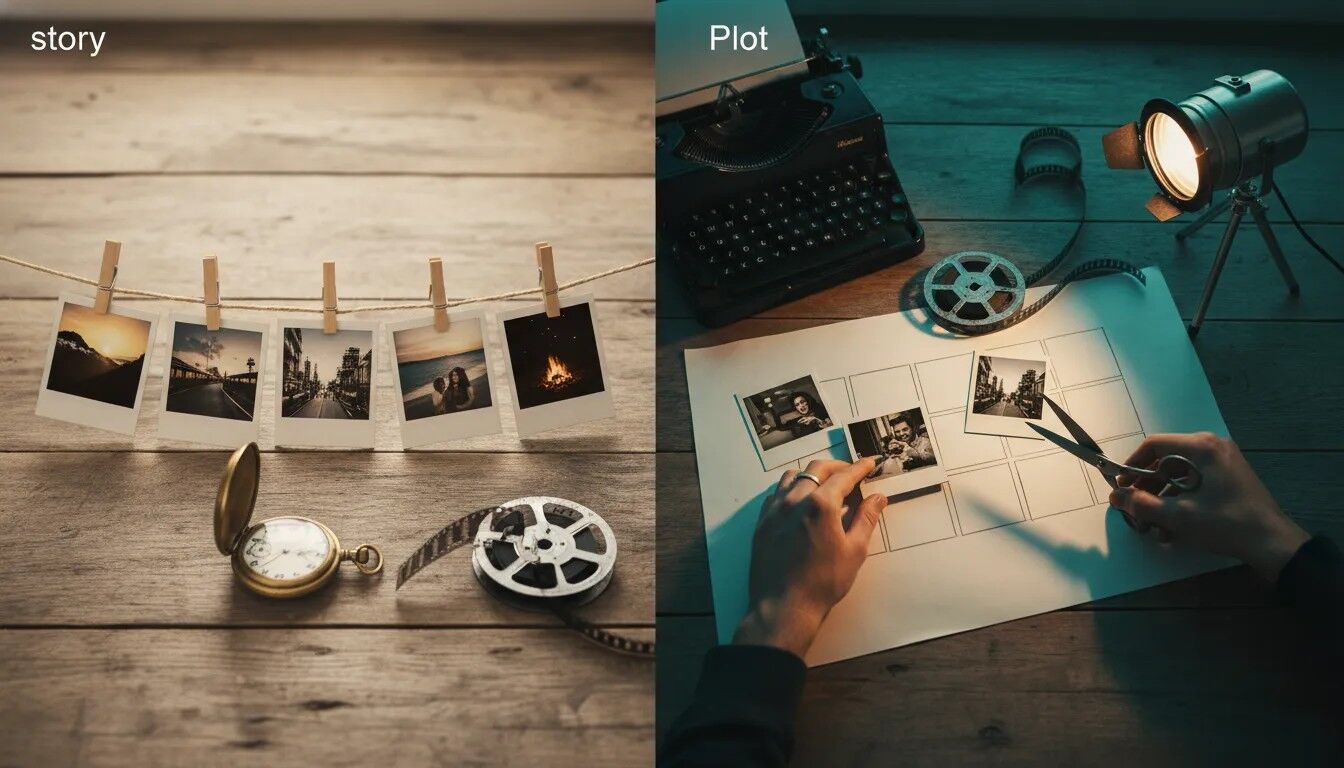
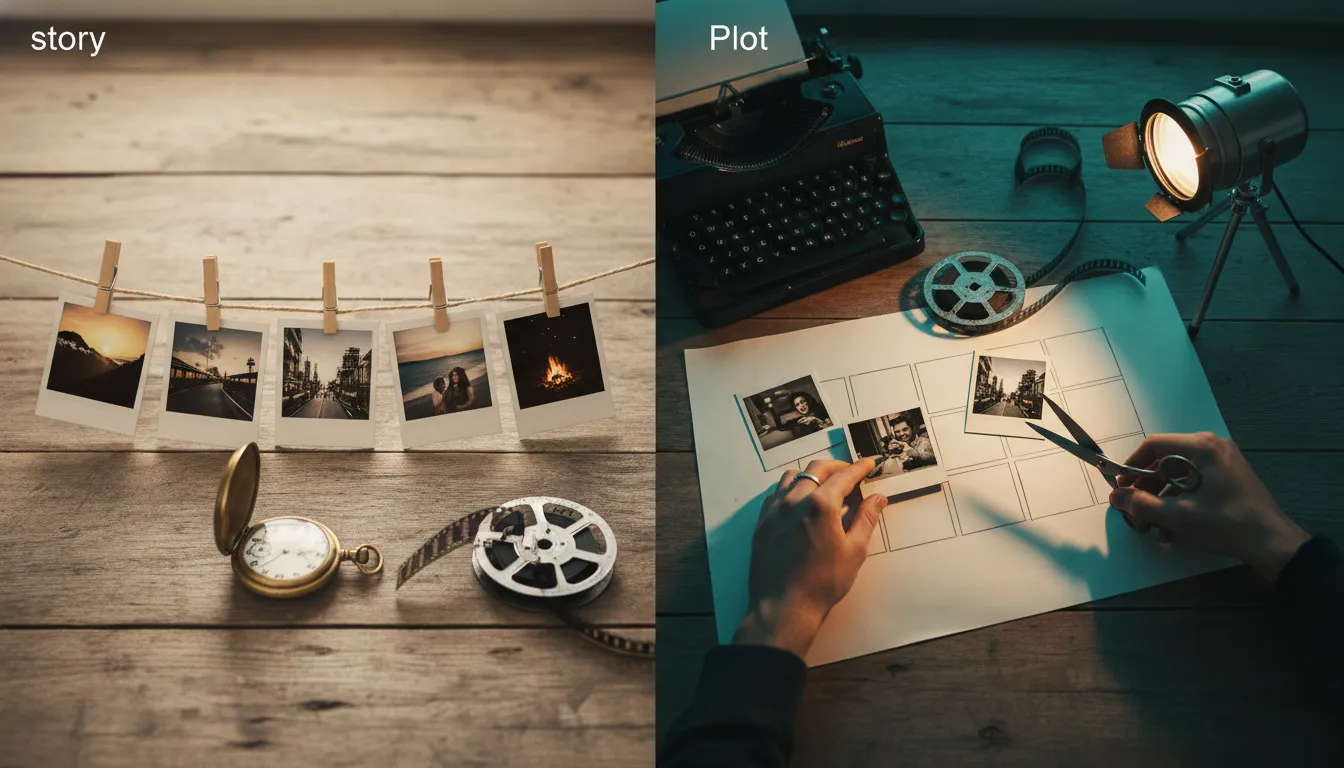
Story is the chain of events that happen to characters. It is the chronological record of lives, choices, accidents, and consequences. If you imagine life as a long line of things that happened, the story is that line: the raw facts of who did what, when, and to whom.
Plot is the way you present that chain to an audience. Plot is an act of selection and arrangement. It decides which events to show, which to omit, how to order them, and how to reveal them emotionally. Plot shapes the rhythm, perspective, and emphasis that turn a sequence of events into meaning.
The distinction may sound semantic, but it is practical. Confusing story and plot leads to problems at every stage of writing. When you treat plot as if it were the only thing that matters, you risk creating elaborate mechanisms that lack grounding in believable human lives. When you treat story as the same as plot, you may assume that every chronological detail must appear on the page or screen — which would sap momentum and clarity.
Why this distinction matters
Understanding the difference frees you to work on both levels without conflating them. Once you accept that there are two separate tasks — inventing a believable world of events, and then choosing how to dramatize those events — you can make clearer creative choices.
- Story gives depth: It supplies the emotional weight behind character actions. If you know the full backstory of what happened to a character, your choices about their present behavior will feel organic.
- Plot gives focus: It determines how the audience receives information and how suspense, surprise, and empathy are orchestrated.
- Respecting both prevents shallow storytelling: A clever plot twist without a solid story foundation can feel cheap. A compelling story poorly plotted can feel aimless.
Think of story as the events in a person’s life and plot as the edits you apply to turn that life into an experience for other people. That edit is not neutral. Choosing to show a moment as a flashback, cutting a scene for pace, or rearranging sequence for dramatic irony all alter how the audience experiences the story — but they do not change what happened in the fictional reality you created.
Hamlet as a classroom example
Classic works give a sharp lens on this distinction. Take the familiar example: in the story, Hamlet’s father dies. That is an event in the fictional world. Everything that follows — Hamlet’s grief, his suspicion, his speeches, the final catastrophe — springs from that event.

Plot, however, can alter the route to that catastrophe. Does the story include a ghost who explicitly says the king was murdered? Does it present evidence of poison, or does the adaptation avoid supernatural explanation and present Hamlet as simply enraged and erratic? Those are plot choices. They do not change the event that the king died. They change how the audience understands and experiences Hamlet’s motives and the story’s moral architecture.
Now imagine telling the Hamlet story from a different vantage point: two minor characters who are dragged through events they do not comprehend. This reorientation does not change the facts of the world — kings still die — but it reframes the emotional core and the thematic thrust. What was once a royal tragedy becomes an exploration of being swept along by forces beyond your knowledge.
How plot reshapes experience without changing the underlying story
That reframing is powerful because it allows the storyteller to explore different questions. One version of Hamlet asks how an individual responds to grief and betrayal. Another asks what it feels like to be an eye witness, to be minor players in a larger drama. The same events produce different insights depending on the plot you choose.
Plot manipulates perspective, emphasis, and timing. Some common devices include:
- Nonlinear order: Flashbacks and flashforwards change cause-perception. If you see an outcome before the cause, you watch the story searching for reasons.
- Point of view shifts: Telling the same events through different characters’ eyes highlights different moral and emotional elements.
- Omission: Cutting everyday moments forces attention onto the essential turning points.
- Delay of information: Withholding facts creates suspense or surprise.
Those devices do not alter the fictional reality — they alter how the audience builds an internal model of that reality. Respecting the characters’ lived experiences, even when you choose to hide large swaths of them from the audience, is key. Plot is not meant to deceive the characters; it is meant to craft the audience’s experience.
From wanting to be in art to wanting to make it
Many people begin as fans. They want to be inside stories — to be an adventurer in a mystery, a lover in a romance, or a spy in a thriller. Reading and watching stories creates memories and emotional experiences that can feel as real as anything in life. They become part of who you are.
That longing to be in the story sometimes flips to a different desire: the urge to create the story. The moment someone realizes they cannot become the fictional hero but can become the creator of heroes often marks a turning point. Making art becomes the project of designing experiences for others to live through.
Once you accept this role, your relationship to story and plot changes. You no longer just consume; you invent. This requires learning to think on two levels — crafting believable events and then deciding how to show them. The creative joy is not only in the world you invent but in the decisions you make about revealing it.
Living in art is real

There is no hierarchy that places living in art as less legitimate than living in physical travel or conventional achievement. Memorable scenes from books, movies, and songs lodge in memory and shape your inner life. Whether you remember a single line, a color in a scene, or an entire arc — these are experiences you have had.
Those borrowed memories are your memories now. They become reference points for emotion, moral thinking, and imagination. Many writers and creators intentionally allow their inner lives to be enriched by these experiences because they provide raw material for making new work.
Three relationships people have with art
Understanding how people connect with art clarifies both audience and creator dynamics. Broadly speaking, there are three kinds of relationships:
- Minimal or decorative engagement: For some, art is a pleasant accessory to life. It decorates spare hours and does not command strong feeling. This is an entirely valid way to live and often necessary in professions with little downtime.
- Fan/lover without maker ambitions: Many people love art intensely but never wish to create it. They read, gather, discuss, and adore. Their lives are richer for it and they play an important role in sustaining cultural conversation.
- Artist/creator: A portion of people both love art and feel compelled to make it. This group faces the labor of craft and the persistence required to shape inner visions into public work.
None of these positions is morally superior. Each fits different temperaments, schedules, and talents. Recognizing where you fall helps you set productive expectations.
Why not everyone who loves art becomes an artist
Loving stories does not guarantee the ability to make them well. There are specific, often strange, mental habits and skills that good storytelling requires: a tolerance for long periods of setup, the willingness to fail repeatedly, pattern recognition across scenes, and a capacity to hold multiple points of view in tension. Those are learnable, but they take time and effort.
Equally important is the reality that making art is not always materially rewarding. Professional paths in writing, filmmaking, and other creative industries are changing and often are harder to monetize. Fame and financial stability are exceptions rather than rules. For many, the intrinsic reward of shaping an experience is the primary payoff.
Practice, persistence, and realistic expectations
If you want to make stories, accept that the early work will rarely match the vision in your head. That gap is not a failure of desire; it is the natural consequence of the craft. The more you practice, the more your internal instincts align with outward results.
Practical habits that help include:
- Write regularly: Even bad pages build the muscle of storytelling.
- Fail fast and learn: Short projects, experiments, and scenes teach what works without draining morale.
- Read widely and actively: Study how other writers handle exposition, reveal, and pacing. Notice what feels authentic and what feels manipulative.
- Talk about stories with other lovers of art: Conversation refines your instincts and keeps you connected to your audience’s experience.

Remember that being an artist is partly about a particular kind of obsession: you are compelled to create even when the results fall short. That compulsion is important because it gets you through the long, often lonely apprenticeship that leads to work that truly sings.
Common mistakes writers make when they conflate story and plot
Here are recurring errors and how to avoid them.
- Overplotting: Believing a clever sequence of events is the story itself. Fix: Ground every turning point in character motivation and consequence.
- Excess backstory dumping: Treating the story as identical to the plot and forcing every historical detail into the narrative. Fix: Use backstory as texture. Only reveal what the audience needs to understand the present turn.
- Plot-driven characters: Making characters do things because the plot requires them rather than because the characters would plausibly do them. Fix: Let character logic drive choices; the plot should emerge from those choices.
- Misplaced emphasis on structure rules: Treating structural beats as sacrosanct and forgetting the human content. Fix: Use structural tools as guideposts, not dictators.
How to think about character, story, and plot together
Three lenses will keep your work cohesive:
- Character lens: Who are they? What do they want? What are they willing to risk?
- Story lens: What actually happens in their life regardless of how you will show it? Know the chain of events in chronological order.
- Plot lens: How will you present those events to best evoke emotion, curiosity, and meaning in your audience?
Working through these lenses in that order is useful. Start with fully imagining the character and the raw events. Only then decide how to structure the delivery. This approach ensures that plot choices remain faithful to the character’s experience and the story’s reality.
An anecdote on discovery: the moment someone chooses to create rather than inhabit
Very often, a particular piece of writing or an account of how a popular author worked can trigger the switch from fan to maker. Discovering that someone invented the hero you loved can be liberating. If you cannot be the spy you admired, maybe you can become the author who invents spies.
That shift reframes longing. Instead of asking, How can I be inside this enchanting world? you ask, How can I design a world that lets others feel that enchantment? The question is less romantic and more procedural, but it is also more durable. It creates a job you can practice.
Regret, humility, and the value of different lives
Creatives sometimes look back with regret — time wasted reading rather than producing, a contemptuous attitude toward those who do not love art, missed opportunities for balance. Those feelings are human and informative.
One useful realization is that a life can be full and valuable with little art. People whose work consumes them — doctors, parents, technicians — often have different priorities and joys. Judging them from the vantage of a storyteller is both unfair and blind to the complexity of human flourishing.

Humility matters. Recognizing that not everyone will be obsessed in the same way frees you to appreciate the role of different people in society. It also helps you navigate relationships and career choices with less corrosive certainty.
Practical exercises to separate story and plot in your own work
Try these exercises to sharpen both muscles.
- Write a chronological biography: Choose a character and write everything that happens to them in order, from birth to a chosen endpoint. Include small domestic details and accidents. Do not worry about literary polish. This is your story ledger.
- Cut the mundane: From that ledger, select the 6 to 10 events that feel most emotionally potent. These are your potential plot anchors.
- Reorder for reveal: Try rearranging those anchors into three different plot orders: chronological, starting in medias res, and starting with the aftermath. Note how each arrangement changes the audience’s questions and alignment.
- Shift POV: Retell one anchor event from two different characters’ points of view. Notice how the meaning shifts even though the event stays the same.
- Omit deliberately: Create a short version of the story where you leave out one major event from the ledger and let the audience discover it through implication. Practice trusting readers to infer.
When to favor story-first and when to favor plot-first
There is no universal order that guarantees success, but here are some heuristics.
- Favor story-first when: You want character-driven drama, emotional realism, or a deep psychological exploration. If the stakes are internal, know the full emotional history first.
- Favor plot-first when: You are writing a high concept mystery, a twist-driven thriller, or a piece that relies on structural surprises. In those cases, plot mechanics may come earlier, but they still must be grounded in plausible causes.
- Blend both when: You aim for genre work with strong characters. Most enduring stories balance a tight plot with authentic internal journeys.
Key takeaways
Story is the what; plot is the how. Invent a believable chain of events and then choose the way you show it. The better your grasp of both, the more powerful and satisfying your work will be.
Respect character reality. Plot choices should feel true to the characters you invented. When characters act only to serve the plot, audiences detect the artifice.
Practice deliberately. Making art is a skill built through repeated failure, revision, and experimentation. Short assignments and frequent feedback accelerate growth.
Value your relationship to art honestly. It is okay to be a devoted fan without becoming a maker. It is also okay to be a maker who sacrifices wide consumption for the labor of creation. Know what you want and shape your habits accordingly.
What is the difference between story and plot?
Story is the chronological sequence of events that happen to characters. Plot is the arrangement and presentation of those events to an audience, including choices about order, perspective, and what to reveal or withhold.
Can a plot change the story?
Plot does not change the underlying events in the fictional world; it changes how those events are revealed and experienced. However, plot choices can alter perceived causality and meaning, which feels like a change in the story’s impact.
Should I invent the whole story before plotting?
There is no single correct process. Many writers benefit from imagining the complete life of characters first to ensure authenticity. Others start with a plot hook and discover story details through drafting. The useful approach is the one that keeps your characters acting plausibly while maintaining momentum.
How do I avoid plot-driven characters?
Anchor every major action in a character’s established desires, fears, and limitations. If a character must do something for the plot, ask what internal or external pressure would make that action feel inevitable for them.
Is professional art better than amateur art?
Professional status does not equal superior art in every case. Paid creation can bring resources and feedback, but many creators find deep satisfaction and craft development in amateur or private work. Artistic value comes from emotional truth, craft, and resonance, not just professional recognition.
How can I practice separating story and plot?
Write a chronological list of everything that happens to a character. Then select the key events and experiment with reordering, changing point of view, and omitting details. Practice small exercises to learn how different plot choices shift audience experience.
Final thought
Understanding the distinction between story and plot is less an academic exercise and more a practical toolkit for anyone who wants to shape experience. Treat the story as the real lives you invent. Treat the plot as the craft of guiding someone through those lives. When both are respected, you can create work that feels inevitable and surprising at once — the rare and satisfying combination that great stories deliver.


