

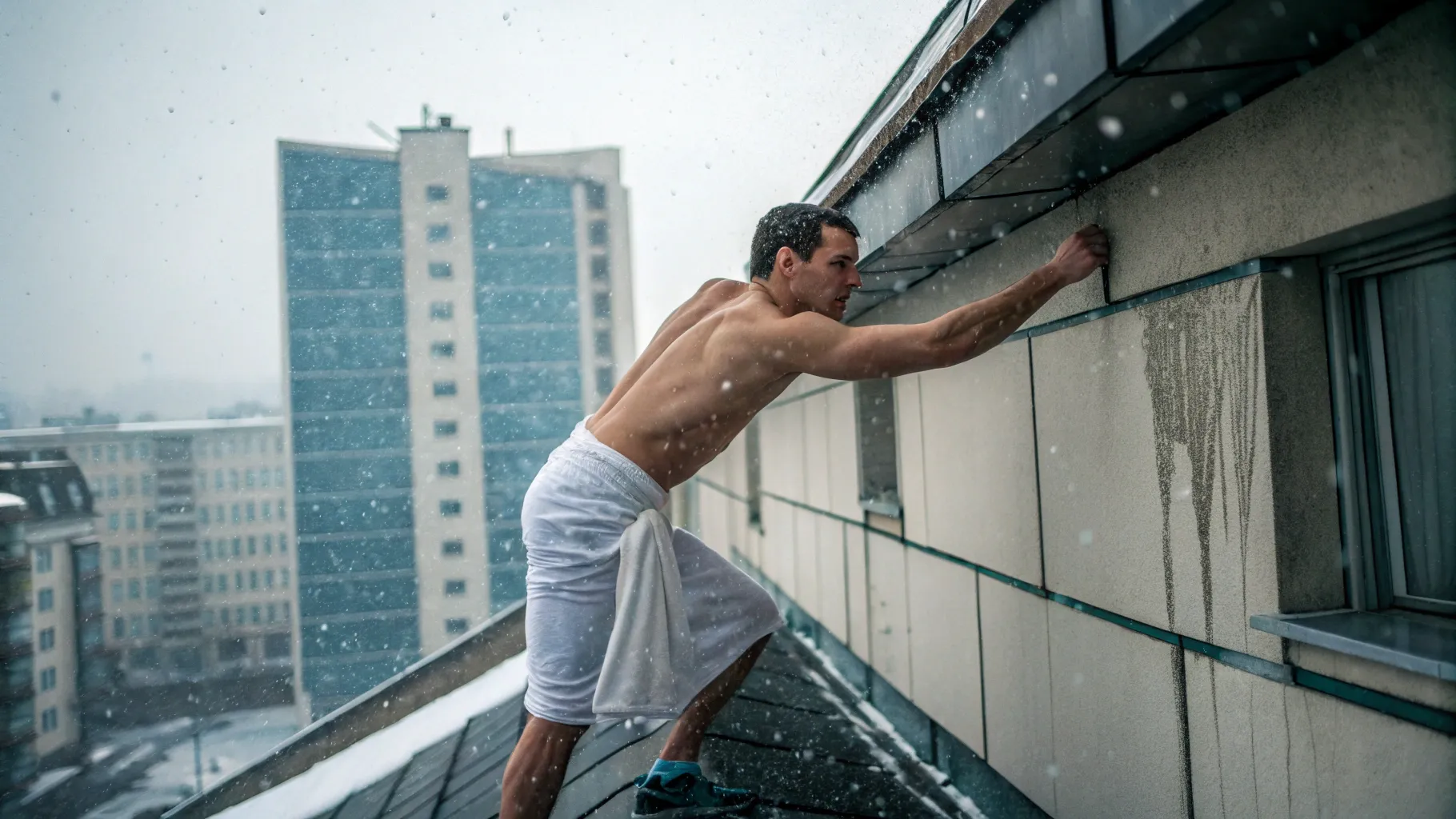
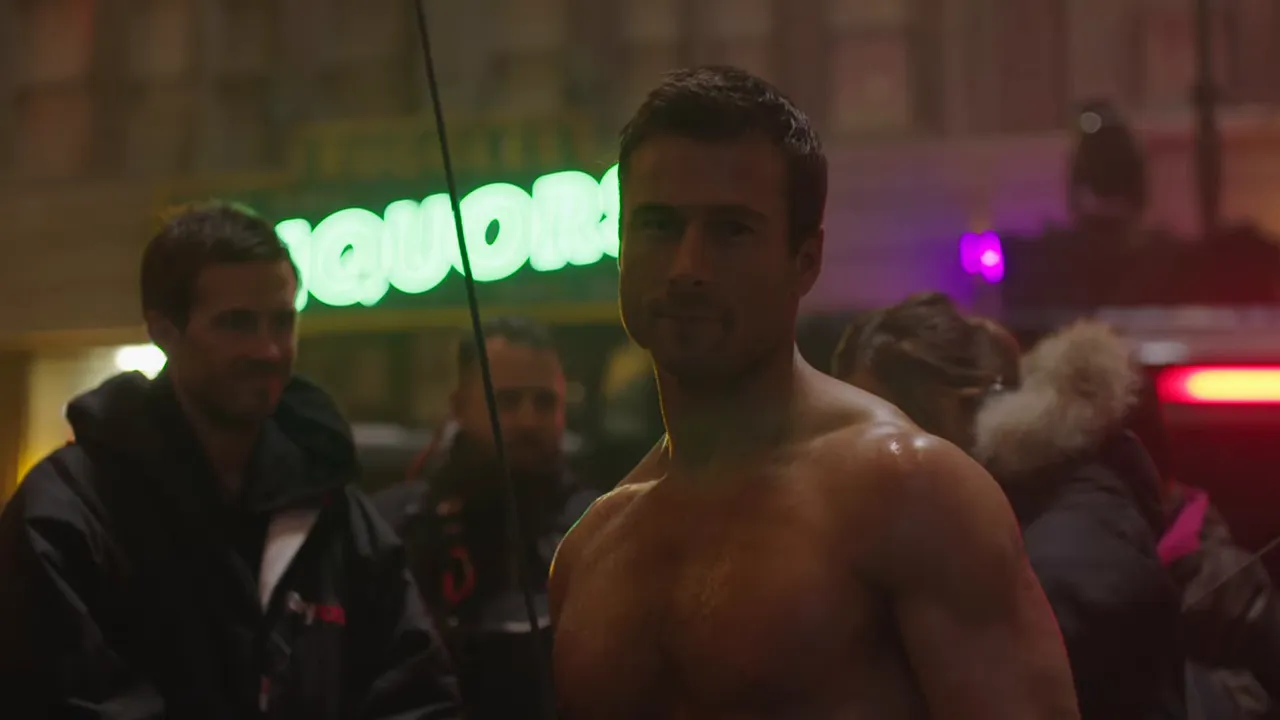
It is February in Bulgaria and I am literally standing on the side of a building in a towel. I say literally because there is no wig, no oversized coat, just a towel wrapped around my waist and a very cold wind reminding me that sometimes the truth of a scene lives in the smallest, most ridiculous-looking details. The shot starts with me on the side of a building. From there I go up on the roof, then drop down the far side and climb back into my room from the outside. That sequence is short, visceral, and, yes, a little bit ridiculous. But that is the point. The Running Man is all about extremes and extremity breeds honesty if you let it.
Table of Contents
- Why this single shot matters
- On location: February in Bulgaria
- Starting off on the side of a building: the moment and its meaning
- Going up on the roof and then down the side
- Telling story through costume minimalism: the towel
- Contextualizing the scene in the world of The Running Man
- Choreography and safety: how we balanced risk and realism
- No harness. No fear. Just a towel
- Performance choices in a vulnerable outfit
- Camera language and editing that sells the movement
- Directorial approach and the tone of the film
- Sound design and the cold
- The emotional through-line: desperation, love, and grit
- Costume, continuity, and practical considerations
- Performance beyond the towel: the actor’s toolkit
- How a single sequence becomes a promotional touchstone
- Collaboration with the stunt and second unit teams
- Moments of levity: keeping morale on a cold set
- The final take: “We’re good, baby. Now it’s running, man”
- Filmmaking lessons from a towel-clad rooftop
- Why audiences respond to vulnerability in spectacle
- Final thoughts and an invitation
Why this single shot matters
At first glance the image of a man in a towel scaling a building might look like a gag or a quick stunt for internet virality. It is both. It is also an encapsulation of what the movie is trying to do: collapse the grand and the intimate into one moment. The Running Man is a near-future story about spectacle and survival. The larger narrative is about a nation hooked on a deadly television series where the Runners are hunted for sport. At the micro level, you watch a man in a towel try to be resourceful, brave, and ridiculous all at once. That collision is electric.
This shot is a portal into the film. It exposes our protagonist as resourceful and unglamorous. He is not a trained athlete or a superhero. He is a father willing to look foolish, to get cold, and to improvise. The towel becomes a symbol. It is his last bit of dignity, the last normal thing he owns before the show strips him down to his instincts. That is cinematic shorthand for the audience. They laugh, they wince, and then they root for him. That emotional arc is exactly what we wanted.
On location: February in Bulgaria
Filming in Bulgaria in February is a character of its own. It shapes every movement, every breath, and every shot. The air is thin and sharp. The sky has that hard, clinical winter light that can be cruel or cinematic depending on how you lean into it. For this sequence, we leaned in. There is nothing like the honesty of cold on skin to make a performance feel lived in. The towel did not hide that. If anything it emphasized it.
Shooting in Bulgaria also meant working with a crew that knows how to turn a skeletal city block into an immersive world. The production designers dressed the facades in wear-and-tear shouldering the film’s near-future aesthetic. Practical details like signage, weathering, and small props made the setting believable. Those elements matter because the audience can tell when a place feels built or merely suggested. When I move along the building’s side and jostle the metal railing or grab the edge of a rooftop, those contact points anchor the camera and the viewer.
Weather logistics were a daily negotiation. We monitored wind and temperatures constantly. Those conditions affected everything from continuity to the physical safety plan. My decision to do parts of the movement with minimal rigging came after a long conversation with the stunt coordinator, the second unit, and our director. They prepared for contingencies. Still, there is a different energy when your teeth are cold and you are in a towel versus when you are under a coat and dry. That energy shows on camera.
Starting off on the side of a building: the moment and its meaning

“We are starting off on the side of a building.” That line is a simple staging note in the moment but it is a loaded directorial choice. Choosing to begin a scene on the exterior face of a building changes how the audience reads the character. It makes him immediately exposed and on display, echoing the film’s central premise that people are watched and judged for thrills. It visually ties the personal to the public. In one breath we see a private action executed in a public register. The towel becomes a signifier of vulnerability under observation.
From a production perspective, starting on the side of a building requires a choreography of camera, performer, and safety. We rehearsed the block many times. Markings were placed out of frame so I could feel confident about the movement. The practical camera angles were mapped to give the sensation of height without losing the intimacy of face and breath. The cinematography wanted to carry the claustrophobia of immediacy but also the vertigo of exposure. That balance was crucial.
Going up on the roof and then down the side
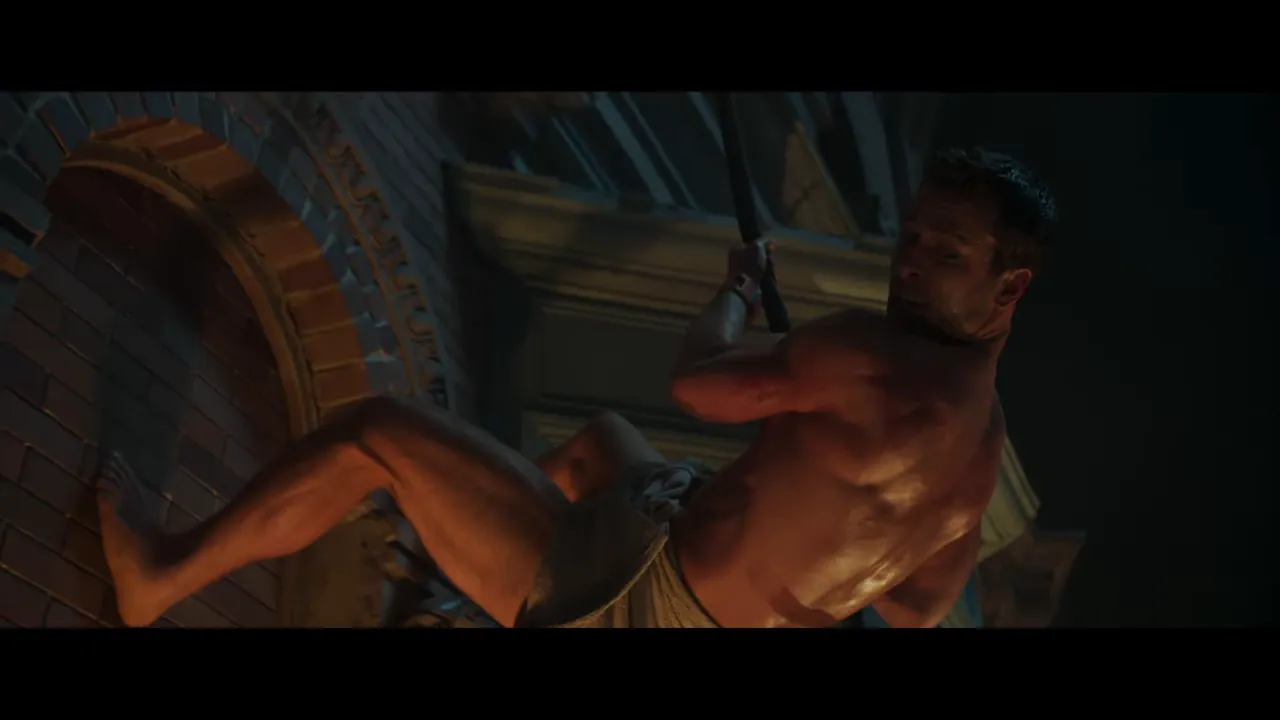
One of the most technically demanding gestures in this little sequence is the transition from roof to side to room. You have to climb up, find purchase, pivot, and then descend under a frame that has been used to choreograph the eye line of the character and the camera. It is physical work disguised as casual movement. In a movie full of spectacle, small physical commitments like a rooftop climb carry emotional weight.
We blocked the climb to read in a single breath. You need to feel the strain but not turn the scene into a montage of physical exertion. The choreography had to let the audience follow without fuss. If the movement became an exhibition of technique, it would highlight the actor instead of the story. Instead, we wanted effort and focus that reads as survival-first instinct. That made every step feel consequential.
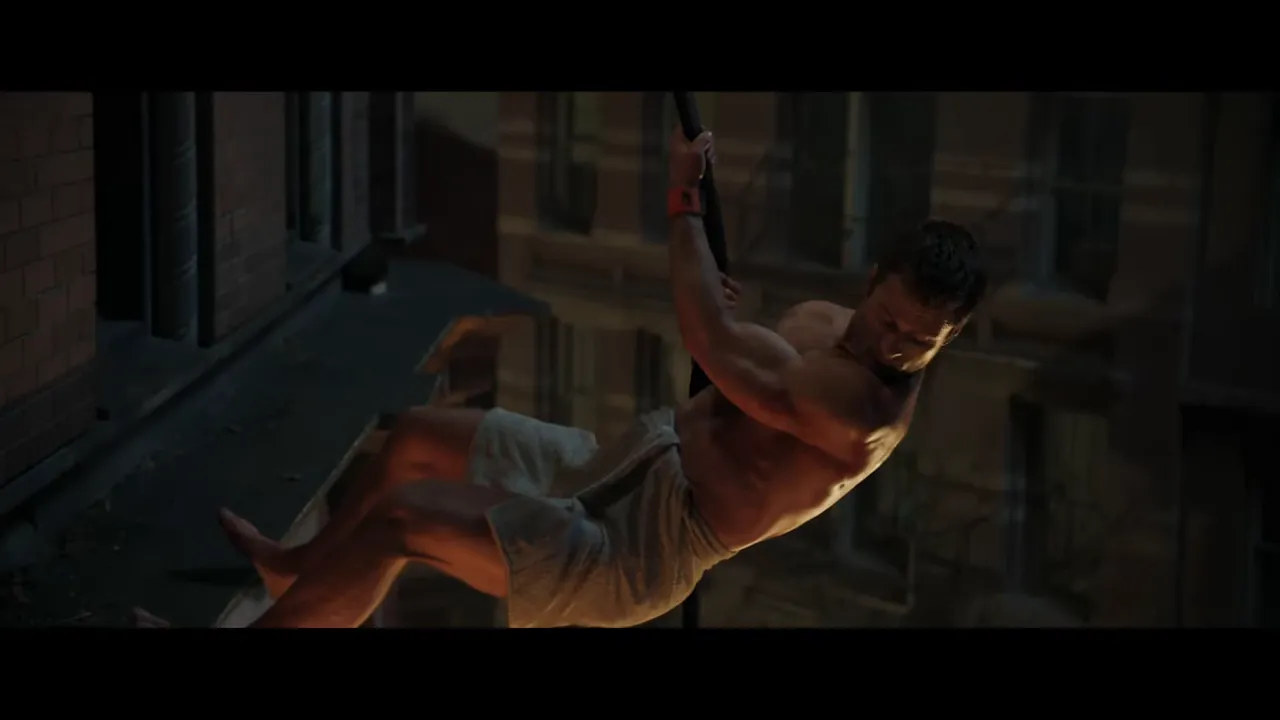
The descent down the side of the building is where the sequence gets its rhythm. There is an instinctive human response to seeing a body traverse a wall. It looks unnatural and therefore demands justification on camera. We used vertical movement as a visual metaphor for the character’s situation: climbing toward safety, then descending into more precarious territory. That oscillation became a heartbeat for the scene.
Telling story through costume minimalism: the towel
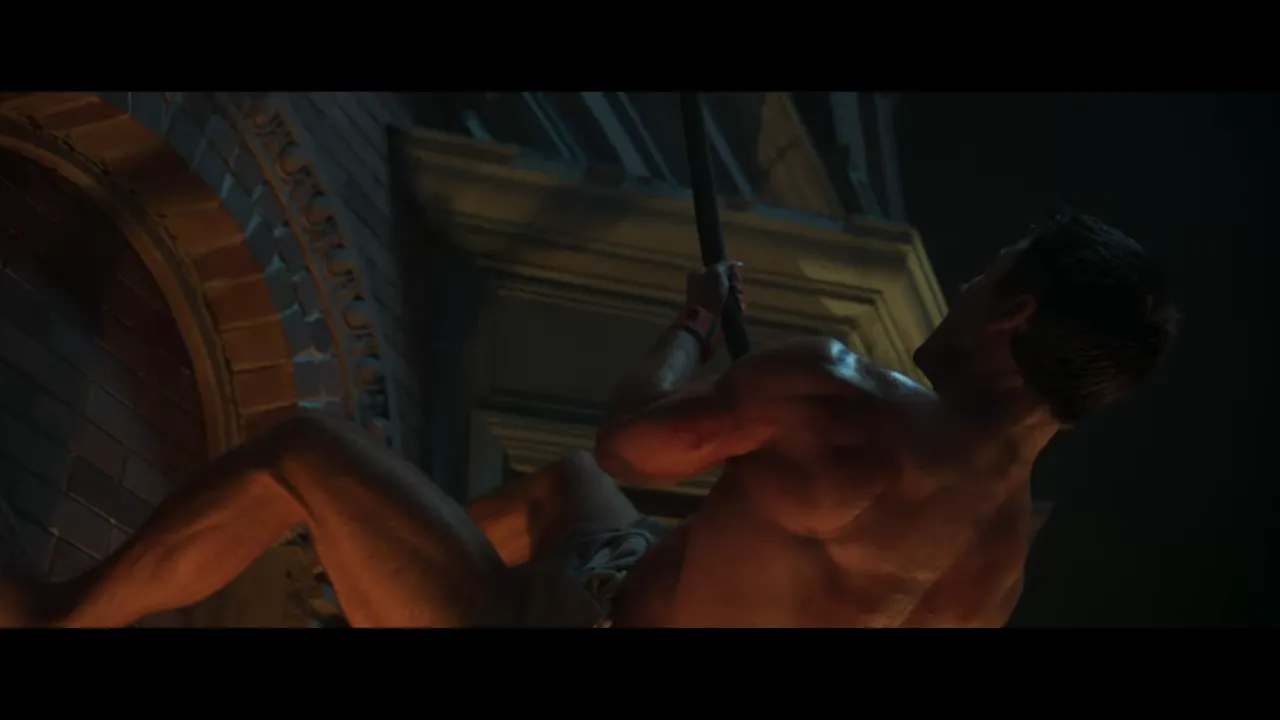
Why a towel? It is deliberately absurd but also brutally honest. In a world where spectacle is currency, stripping someone down to a towel is both humiliation and liberation. It shows the rawness of the man. There is no armor, no branding, no tactical gear. Only a towel and what the camera can catch. The simplicity of the costume pushes the audience to invest in the person rather than the gadgetry.
That choice also allowed us to talk about dignity. The protagonist is not a gladiator with safe gear. He is a father who will do anything for his daughter. That desperation is unclothed. There is a vulnerability that can be easily exploited for a laugh. But instead of playing the towel for pure comedy, we leaned it into pathos. The audience laughs because the image is funny, but the laugh is immediately undercut by the stakes. That sweet spot is rare and powerful.
Contextualizing the scene in the world of The Running Man
The Running Man universe is a near-future society where the highest-rated show is a hunt. Contestants, called Runners, must survive 30 days being pursued by professional Hunters. Each day survived brings a greater cash reward and more public scrutiny. The show is engineered to nationalize appetite for spectacle. That world is essential to understand why my towel jump matters. He is not just escaping a physical threat; he is attempting to maintain agency in a system designed to dehumanize him.

Our protagonist, Ben Richards, is a working-class man driven by love and desperation. He enters the game to save his sick daughter and is convinced to do so by the show’s charismatic but ruthless producer, Dan Killian. The emotional core of Ben’s journey is not the chase itself but his navigation of a world that profits from his pain. The towel scene is a microcosm of that arc. It hints at the larger mechanics of spectacle while grounding the story in a human, absurd, and honest moment.
Choreography and safety: how we balanced risk and realism
People often ask if stunts like this are real. The short answer is that some of it is real, and all of it is planned. We had an expert stunt team that crafted a safety net behind the camera, out of frame, and used hidden supports where necessary. But abundant safety does not negate physical risk. The cold makes surfaces slick. A towel offers little grip. That combination requires a robust safety protocol and clear communication between performer, stunt coordinators, and the second unit.
We rehearsed on a mock-up before going to the real building. The rehearsals were not just for movement; they were for breathing, timing, and trust. The team and I developed a shorthand. A hand signal meant stop. A specific line meant we were good to go. There’s a psychological element to that type of trust. When you know the crew has your back, you can commit more fully to the performance. That energy translates to the screen as truth rather than a safety exercise.
No harness. No fear. Just a towel
We leaned into the phrase “No harness. No fear. Just a towel” as a playful tag for the moment, but it also captures a methodological approach. The decision to minimize visible rigging was aesthetic. Modern film allows us to conceal safety equipment in ways older cinema did not. We used an array of camera tricks, stunt doubles for the most dangerous shots, and precise editing to stitch together the illusion of one continuous movement.
There are also ethical reasons for minimizing visible harnesses. If the audience sees the safety nets, the emotional vulnerability evaporates. They become spectators to a trick, not witnesses to an ordeal. Removing visible harnesses preserves the illusion while maintaining real-world safety. It is an illusion engineered with real care.
Performance choices in a vulnerable outfit
Acting in a towel is not about bravado. It is about commitment to small details. How you hold your shoulders, the catch in your breath, the way you clench your jaw when wind stings your ear, all of these elements are readable on camera when you strip everything else away. The towel becomes a constraint that forces you to decide what gestures matter.
I chose to localize my performance in the eyes and small physical habits. There is a lot you can communicate without grand gestures. An inch of hesitation before you dive through a window tells the audience as much as a scream. The small, human choices are what fuse the physical stunt to emotional stakes. Otherwise, it is just an impressive bit of athleticism with no narrative weight.
Camera language and editing that sells the movement
The camera has a tempting option: it can fetishize the motion with dramatic slow motion and lingering close-ups. We resisted that impulse in favor of momentum. The shot needed to feel like it belonged to a continuous timeline rather than a highlight reel. That meant a handheld sensibility for parts of the sequence, crisp cuts to maintain pace, and a couple of longer takes where the performer carries the rhythm.

Editing plays a big role in maintaining realism. When you cut away to a wide, you reestablish geography. When you cut to a close-up, you register emotion. Those cuts must be placed to help the audience breathe without losing the sequence’s forward thrust. Our editorial choices were designed to keep the viewer oriented while also conveying the frantic improvisation the character is forced into.
Directorial approach and the tone of the film
Working with a director who gravitates toward precise visual grammar was a gift. The Running Man balances satire and sincerity. It is meant to be a darkly comic critique of spectacle while also a thriller about survival. That tonal balancing act is tough. One false move and the film could either become too earnest or too detached. For this sequence, the directive was clarity of purpose: be funny when the moment calls for it, be terrified when it must hurt, and never let the spectacle override the human center.
The director encouraged spontaneous moments within a structured framework. There are beats we planned meticulously and beats we invited to happen. The towel scene has both. A planned beat might be the roof pivot; an invited moment might be the way a gust of wind forces me to grip the towel tighter. Those spontaneous physical responses are what give the scene texture.
Sound design and the cold
Sound is the invisible partner that sells physical risk. There is a difference between a scene that looks dangerous and one that sounds dangerous. The creak of a rooftop ledge, the rasp of a gloved hand, the wind tearing at a towel, even the silence of a city waiting breathlessly for the next beat all shape the viewer’s experience. The production sound team captured a lot of the elements on set, and the sound designers layered them to build tension.
Because it was cold, our breath was visible and that was an audio-visual lever we used. Heavy, labored breathing during a climb reads as exertion and fear. It is a small moment but one that humanizes the performer. In a film that trades on spectacle, those human sounds keep the experience intimate.
The emotional through-line: desperation, love, and grit
At the heart of the towel scene is a man doing what he must for the person he loves. The Running Man is about a world that commodifies suffering and a man who refuses to let his identity be consumed by that commodification. His choices are messy, occasionally undignified, and deeply human. That is why an image as absurd as a man in a towel can carry so much weight. It is not about shock value; it is about truth in the face of humiliation.
We wanted to avoid turning vulnerability into a spectacle of suffering. The protagonist retains agency even when he loses comfort. He makes choices. He improvises. He holds on when the more “rational” option might be to surrender. That inner stubbornness is what invites audiences to root for him even when the world cheers for his downfall. The towel is an emblem of that stubbornness.
Costume, continuity, and practical considerations
On paper, a towel sounds simple. On set, it is a continuity headache. Towel placement, dampness, and marks can change between takes. Those details matter because our camera loves continuity but also cares about texture. If a towel reads different between shots, the audience will feel a hiccup they cannot name. The wardrobe team worked overtime to maintain exact placement, to swap towels that became wet, and to keep an eye on plausible wear. Small things like a wet towel clinging differently can read as a continuity break if not handled carefully.

We also had to think practically about modesty and the actor’s comfort. Even though the scene calls for audacity, we never sacrificed respect. There were closed sets for certain takes, and wardrobe doubles where appropriate. The production team balanced the joke, the emotional weight, and the actor’s dignity. That balance is non-negotiable in a healthy set environment.
Performance beyond the towel: the actor’s toolkit
There is a toolkit actors use when the physical demands outstrip the verbal. Breath, eye focus, micro-expressions, and gesture become the grammar to tell the story. In a scene with little clothing and a lot of motion, those tools magnify. You cannot rely on a costume to do emotional heavy lifting. The performance has to inhabit the space and carry the emotional logic through movement.
In rehearsal, we worked on breath control under duress, on how to pace panic, and on how to make small choices land in big ways. The actor’s job is to bring interior life to visible action. You do not want the physical action to look imposed. It must feel inevitable and chosen. That is the challenge and the joy.
How a single sequence becomes a promotional touchstone
Moments like the towel climb often become shorthand in promotion because they are easy to describe and hard to forget. Audiences latch onto a singular image that captures the tone of the entire film. In this case, the towel moment signals humor, danger, and an everyman spirit. It gives people something to talk about and share. But there is risk in leaning too heavily on a single moment. You want that beat to invite curiosity, not to reduce the film to a single gag. The promotional team is mindful of that tension and aims to use the image to open conversations rather than to box the film in.
That is also why we made sure the shot belonged to a character arc. If the towel climb had been a one-off stunt with no emotional payoff, it would likely have felt hollow. Instead, it sits within a narrative that reveals character, motivation, and stakes. A memorable image should do more than get attention. It should reveal the story.
Collaboration with the stunt and second unit teams
Good stunt work is invisible by design. It is there to service the story and the actor. The second unit crafted several shots that played with perspective and timing to sell the danger without unnecessary risk. Their work in building rigs, staging camera-lift shots, and coordinating safety personnel was indispensable.
We relied on a mixture of approaches: practical movement by the actor, a stunt double for the highest-risk moments, hidden harnesses in certain placements, and digital clean-up where needed. None of that diminishes the physical courage required. It simply illustrates how modern filmmaking is a choreography of specialists. Each specialist added a layer of safety and artistry that allowed the sequence to breathe.
Moments of levity: keeping morale on a cold set
When you are in a towel and it is cold, humor becomes a survival tactic. The crew and I cracked jokes, improvised warm-up rituals, and kept the set’s energy buoyant. Those moments of levity are essential because they allow an actor to commit without the pressure of doom. It is an odd paradox: to convincingly sell terror, you sometimes need a room full of people laughing before the take. That tension keeps the mood human.
We also had rituals for warming between takes. Warm blankets, hot water bottles, and short, efficient rehearsal runs helped preserve the physical stamina necessary for multiple takes. A well-cared-for performer translates directly to a better performance. That is something producers and crews understand instinctively.
The final take: “We’re good, baby. Now it’s running, man”
There is a small, private satisfaction when a take lands. You can feel it in the exhausted hush on set when everyone knows the elements came together. The moment I climbed, pivoted, and slid back into what the camera considered my room, there was a sense of completion. It is the fulfillment of collaborative risk. The line “We’re good, baby. Now it’s running, man” is less about ritual and more about release. It punctuates the scene and offers a beat of triumph in the face of ridicule and danger.
That phrase is shorthand for the trust you put in your fellow makers. When you say it, you are acknowledging the crew, the stunt team, the director, and the camera operator. You are also acknowledging the character’s reality. It is small and private but it lands with the audience because it is honest.
Is the towel scene meant to be comedic?
The towel scene contains comedic elements but it is not pure comedy. It uses humor as an entry point into vulnerability and drives toward emotional truth. The aim is to balance absurdity with stakes, so the laughter becomes a bridge to empathy rather than a dismissal of the character’s predicament.
Was it actually filmed without harnesses?
Some portions of the sequence were performed without visible harnesses to maintain realism, but safety measures were in place. We used a combination of hidden rigging, a stunt double for the riskier beats, and careful choreography to protect the performers while preserving the illusion of unassisted movement.
Why film in Bulgaria during winter?
Bulgaria offers a versatile production infrastructure, skilled crews, and architecture that suits the near-future aesthetic. Filming in winter provided a natural harshness and a specific light quality that enhances the world-building. The weather added texture and immediacy to scenes, though it required extra planning for safety and comfort.
How does the towel moment connect to the film’s themes?
The towel moment embodies themes of exposure, spectacle, and human dignity. In a world where people are consumed for entertainment, a man stripped to a towel represents the loss of facade and the reveal of core motivation. It encapsulates the film’s interrogation of voyeurism while centering the protagonist’s personal stakes.
Who is Ben Richards and why does he enter the Running Man?
Ben Richards is a working-class father desperate to save his sick daughter. He enters the Running Man as a last resort, persuaded by the show’s producer who offers a dangerous promise of money in exchange for survival. Ben’s journey is driven by love and moral grit rather than spectacle for its own sake.
How can a single stunt serve a larger narrative?
When a stunt embodies character traits and story stakes, it becomes more than a set piece. This towel sequence reveals resilience, improvisation, and vulnerability. It acts as a concentrated moment that foreshadows the film’s larger arc about a man fighting for agency in a world that profits from his pain.
Filmmaking lessons from a towel-clad rooftop
There are practical lessons that apply to any creative endeavor. First, specificity matters. A small, specific choice like a towel can open up narrative possibilities if you commit to its logic. Second, trust your collaborators. The sequence only worked because of the combined expertise of stunt coordinators, wardrobe, production design, and the camera department. Third, constraints breed creativity. A cold day and a minimalist costume pushed us to find imaginative ways to tell the story. Finally, keep the human center present. Spectacle only resonates if it is anchored in empathy.
Those lessons are not movie tricks. They are creative operating principles. Whether you are staging a scene, building a campaign, or solving an editorial problem, the same rules apply. Decide what matters, assemble people you trust, and let constraints force clarity rather than fear.
Why audiences respond to vulnerability in spectacle
Audiences have always loved a paradox: the thrill of seeing someone in danger and the comfort of rooting for their survival. In modern narratives, the lines are blurred because media itself is a spectacle machine. Showing vulnerability within spectacle allows audiences to process the tension between consumption and compassion. A towel-clad rooftop sequence invites people to laugh and then to feel. That movement is emotionally satisfying because it mirrors human experience: we laugh at ourselves and then we remember why we keep going.
When a character shows grit rather than skill, they become accessible. The audience can imagine themselves in the protagonist’s shoes. That identification is the bedrock of engagement. The Running Man uses extreme circumstances to expose ordinary heroism. That is an enduring narrative engine.
Final thoughts and an invitation
This small sequence is an example of how a single image can contain a film’s larger ambitions. A man in a towel scaling a building is funny, absurd, and urgent. It performs many functions at once: it entertains, it reveals character, and it sets the tone for the world we are asking the audience to inhabit. It is a microcosm of a movie that is both a thrill ride and a social critique.
If nothing else, the towel scene is a promise. It promises you will see bold choices, honest performances, and a story that wants to hold your attention while it asks uncomfortable questions. It promises that spectacle can be an entry point to empathy and that a little vulnerability can make a big noise.
We made a lot of deliberate choices to bring this moment to life. The cold, the crew, the choreography, and the small theatrics all contributed to something we hope feels alive rather than engineered. A shot like this is only as good as the intention behind it. Our intention was to reveal a man who is willing to be exposed for love. That, more than anything, is what we wanted you to see.


